LEARNING ENGLISH BY NEWS

Keep update the newest news around the World for you.

PRACTICE LISTENING BY NEWS AND ARTICLE

Now click on the news open audio file to listen the news and article.

EXPLORE THE WORLD

“Twenty years from now you will be more disappointed by the things that you didn't do than by the ones you did do. So throw off the bowlines. Sail away from the safe harbor. Catch the trade winds in your sails. Explore. Dream. Discover.” ― H. Jackson Brown Jr., P.S. I Love You

INSPIRE YOURSELF

Sometimes we all lose inspiration to achieve goals, succeed in our everyday lives and work, and think creatively. Whether you are an artist that wants to produce more creative work; a person with a specific goal in work, education, or fitness; or simply someone who wants to regain enthusiasm for life, learn to get back in touch with the well of inspiration present in all of us..

Showing posts with label new technology. Show all posts

Thursday, February 23, 2017

English In The News: The Future of Shopping "3D Printing and Augmented Reality"

These days, shopping often involves an Internet connection and a laptop or smartphone. However, businesses are now trying to use new technology, such as 3Dprinting and augmented reality, to bring customers back into stores.
At the recent National Retail Federation show in New York City, many companies demonstrated these new technologies. One, the computer company Intel, is experimenting with 3D printing. It is using the Mach 2XS commercial printer.
Instead of printing words on paper, the Mach 2XS prints clothes. For example, it uses thread to print out a sweater. It prints the sweater out row by row, until it is fully formed.
Ryan Parker is the general manager of Responsive Retail at Intel. He says the 3D printers print out clothing, made just for the individual in size and style, in about 45 minutes.
Bringing consumers back to stores
More and more consumers shop online. But young people still seem to like going to physical stores. A recent study shows that 67 percent of people between ages 13 to 21 shop in physical stores most of the time. The IBM Institute for Business Value and the National Retail Federation did the study.
A London-based company, Ads Reality, is trying to use augmented-reality, or AR technology in stores. Augmented reality is a technology that creates computer-generated images and projects them in a way that they look real.
“When it’s used in the right way, it’s a very powerful tool to drive mobile engagement and store traffic,” said Richard Corps, managing director.
The company’s latest product is an “AR Window.” It superimposes life-sized augmented-reality characters on big screens in store windows.
“It looks like those characters are actually inside the store ... it stops people outside the store because they’re amazed to see these characters ... and then it drives them inside the store because they want to have their photograph taken with these characters,” Corps said.
Customer service robots
Customer service robots might also become a common store experience. The New York company Autonomous is experimenting with customer service robots. These wheeled devices include a Wi-Fi connection to a real person who can be seen on the robot’s screen.
Robots in a hardware store, for example, could be operated from anywhere by experts in different fields, like plumbing or electrical wiring.
Autonomous chief Duy Huynh says the robots can make the shopping experience personal.
“With our technology, when you walk into a store one of our robots will approach you and behind the robot, [it’s] going to bring someone who knows your shopping habits, who has been helping you for the past six months, who knows what you need, to talk to you. So to us that’s really, really important and that’s the very first time you can actually do personalization offline.”
I’m Phil Dierking.
_____________________________________________________________

Words in This Story

amaze – v. to fill someone with wonder.
augmented reality – n. a technology that superimposes a computer-generated image on a user's view of the real world.
3D printing – n. the process of making a physical object from a three-dimensional digital model.
character – n. a person who appears in a story, book, play, movie, or television show.
consumer – n. a person who buys goods and services.
customer – n. someone who buys goods or services from a business.
mobile engagement - n. is the level of interaction between a brand and consumer via a mobile device.
product – n. something that is made or grown to be sold or used.
robot – n. a real or imaginary machine that is controlled by a computer and is often made to look like a human or animal.
thread – n. a long, thin piece of cotton, silk, etc., used for sewing.
superimpose – v. to place or lay something over something else.
sweater – n. a warm usually knitted piece of clothing for the upper part of your body.

English In The News: Adverb and Adjective Choices in Conversation

From VOA Learning English, this is Everyday Grammar.
Imagine two American students are talking outside of their school. Let’s listen to the imaginary conversation:
A: Today is going slow.
B: Yeah. I guess we should study for our grammar test.
A: That sounds like a terrible idea.
B: Yeah, but if we don't study, we won't do good on the test.
A: Fine. Let's go study our notes quick. Then we can play video games.
These bad students may hate grammar, but they just taught you some common grammatical structures in conversational American English.
In today's report, we will study how conversational grammar differs from written and formal grammatical structures.
We will show you how some Americans use adjectives and adverbs in casual conversation.
Adjectives and Adverbs
Adjectives are words that give information about nouns. They generally appear before nouns, although they also appear after linking verbs.
Here are two examples:
You are a good student.
Learning English is fun.
In the two example sentences, the words "good" and "fun" are adjectives. They are telling you something about a noun.
Adverbs are often used to modify adjectives or verbs. They give information about reason, manner, time, and so on.
For example, the adverb loudly appears in this sentence:
We sang loudly.
The adverb loudly modifies the past tense verb, sang. It tells about the way in which the subject, we, sang. Adverbs often have an –ly ending, but there are many that do not. You can read more about adverbs in past Everyday Grammar stories.
Conversation:
Let's think back to the conversation we heard at the beginning of the story:
A: Today is going slow.
B: Yeah. I guess we should study for our grammar test.
A: That sounds like a terrible idea.
B: Yeah, but if we don't study, we won't do good on the test.
A: Fine. Let's go study our notes quick. Then we can play videogames.
Notice that the words are used differently from what might be taught in an English class.
In casual conversation, Americans often use adjective forms in place of adverbs. They may use adjective forms to modify verbs.
For example, the students use good – a word that is normally an adjective - as an adverb. One student says "we won't do good on the test."
In writing and in formal conversation, Americans generally do not use the word "good" this way. Instead, they use the word well. In formal writing or speaking, you would be more likely to see or hear the sentence "we won't do well on the test."
Americans also may use an adverb but choose not to say an –ly ending.
For example, the student says "today is going slow," instead of "today is going slowly." You would be more likely to read "slowly" in academic writing, write Susan Conrad and Douglas Biber, two English grammar experts.
Not necessarily slang, not necessarily impolite
These grammatical structures are not necessarily slang. They are not necessarily impolite, either. You might hear some of these structures in a restaurant, at a job fair, or even at work.
For example, a boss might tell an employee "We need to do this quick," about a project that must be completed quickly.
This is the same pattern that the students used in their conversation.
Conrad and Biber say that in formal speech and writing, adjective forms are almost never used to modify verbs. In addition, adverbs with –ly endings are more common in writing – particularly in academic and news writing.*
What can you do?
The good news is this: we are not asking you to memorize any of the patterns we have talked about today.
What we hope to do is show you that the grammatical patterns in conversation do not always match the patterns used in formal writing or speech. There is more flexibility in casual speech.
Understanding this idea will help you understand Americans when they speak, and it will help you sound more natural when you speak to Americans.
You might also be pleased to know that Americans will not judge you severely if you use an adjective in place of an adverb. In fact, they probably would do the same!
I'm Jill Robbins.
And I'm John Russell.
** If you would like to read more about adverbs, you might want to try these two resources:
_____________________________________________________________

Words in This Story

conversation – n. an informal talk involving two people or a small group of people
formal – adj. suitable for serious or official speech and writing
casual – adj. not formal
modify – v. grammar: to limit or describe the meaning of (a word or group of words)
manner – n. the way that something is done or happens
academic – adj. of or relating to schools and education
slang – n. words that are not considered part of the standard vocabulary of a language and that are used very informally in speech especially by a particular group of people
impolite – adj. not polite
pattern – n. the regular and repeated way in which something happens or is done
memorize – v. to learn (something) so well that you are able to remember it perfectly
flexibility – n. able to change or to do different things

English In The News: Driverless Electric Buses Tested in Paris, Las Vegas

More and more cities across the world are experimenting with driverless vehicles on public streets.
Two of the latest to conduct testing are Paris, France and Las Vegas, Nevada. The cities have used self-driving electric buses to carry passengers on short rides to try out the technology and see how humans react to it.
In Paris, two buses have been transporting passengers across a bridge between two of the city’s busiest rail stations. The vehicles, built by French company EasyMile, travel in a special safety lane created for the project. The fully electric buses can carry up to 10 people.
The testing in Paris is expected to last three months. If things go well, officials plan to launch more driverless bus lines later this year.
Jean-Louis Missika is the deputy mayor of Paris. He told reporters at a recent launch event that autonomous vehicles represent a “revolution” happening in many cities around the world.
He said self-driving technology is set to “change our urban environment and public space in a spectacular fashion over the next 20 years.”
Transportation officials say they are planning to use the bus to connect neighborhoods to rail stations around Paris. They will also help ease traffic crowding and reduce severe pollution in the city.
In Las Vegas, the city recently launched the first driverless shuttle bus in the United States.
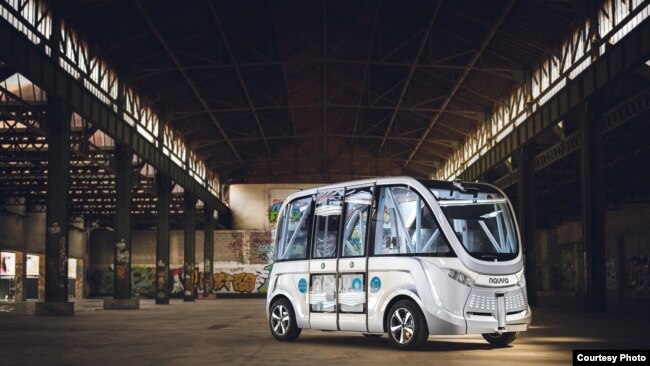
The 12-passenger bus from French company Navya has no steering wheel or brake pedals. It uses cameras and sensors to avoid other vehicles and people while making its way down city streets.
The electric vehicles can reach a top speed of 40 kilometers per hour.
The bus operated for a two-week period along one of the busiest entertainment areas in Las Vegas. Rides during the shuttle experiment were free.
“The ride was smooth. It's clean and quiet and seats comfortably,” said Las Vegas Mayor Carolyn Goodman after taking a ride.
Las Vegas has tested a 12-passenger shuttle bus like this one from French company Navya. Officials hope to deploy more of the buses later this year. (Courtesy: Navya)
Several autonomous shuttle buses are expected to be deployed in Las Vegas later this year to transport passengers through main areas of the city.
The estimated cost of the program is about $10,000 per month. Officials say while this might seem high, the driverless shuttles could still save the city money. The current yearly cost for a single bus and driver is about $1 million.
I’m Bryan Lynn.
________________________________________________________________

Words in This Story

autonomous – adj. existing separately from other things
spectacular – adj. very good or exciting
shuttle – n. vehicle that travels regularly between places
sensor – n. device that detects or senses heat, light, sound, etc.

comfortably – adj. physically well and relaxed