LEARNING ENGLISH BY NEWS

Keep update the newest news around the World for you.

PRACTICE LISTENING BY NEWS AND ARTICLE

Now click on the news open audio file to listen the news and article.

EXPLORE THE WORLD

“Twenty years from now you will be more disappointed by the things that you didn't do than by the ones you did do. So throw off the bowlines. Sail away from the safe harbor. Catch the trade winds in your sails. Explore. Dream. Discover.” ― H. Jackson Brown Jr., P.S. I Love You

INSPIRE YOURSELF

Sometimes we all lose inspiration to achieve goals, succeed in our everyday lives and work, and think creatively. Whether you are an artist that wants to produce more creative work; a person with a specific goal in work, education, or fitness; or simply someone who wants to regain enthusiasm for life, learn to get back in touch with the well of inspiration present in all of us..

Showing posts with label hoc tieng anh. Show all posts

Thursday, February 23, 2017

English In The News: Computer Data and the Business of Mind-Reading


Big data is having an increasing effect on the way we live.
Big data can be defined as information that is too big or complex to be contained or processed by any one machine or person. It can include which comments, photographs or stories you “like” on Facebook’s website.
It also includes seemingly harmless personal information that political campaigns use to reach voters.
The presidential election campaign of Donald Trump used big data to reach American voters who normally would not share their opinions with others. It also helped organizers of the campaign to end Britain’s membership in the European Union, known as Brexit.
Finding out more about people
John Kreisa works in London for Hortonworks, a computer software company that started in California. He says there are lots of ways to measure a person’s feelings.
“One probably very obvious one is things like Twitter,” he says. “Social media, in general, is a way that people express themselves and express a like or dislike...”
By themselves, the trillions of bits of information would just be a collection of countless facts, many of which are considered worthless. But add the power of the human mind and it is a different story.
As a student at the University of Sussex, Julian Dailly had two majors -- English and philosophy. When he completed his studies, Dailly wondered how he would ever earn a living in a world filled with machines and technology. Now, he is part of an industry that includes Google and Facebook. It is so large no one seems able to estimate its worth.
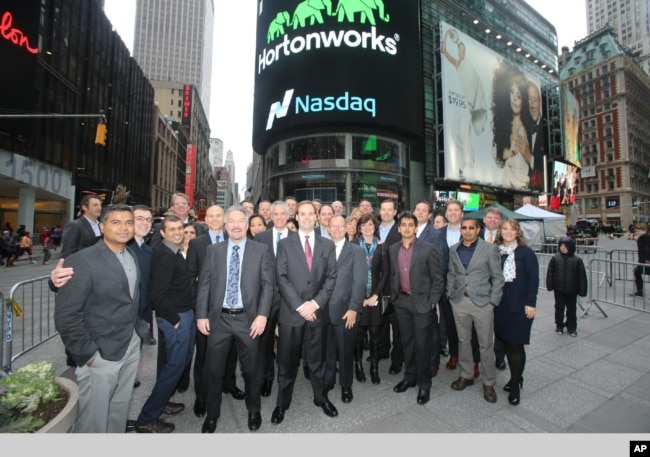
FILE - Hortonworks, Inc.Hortonworks, Inc., a California software company, opened for trading on The Nasdaq Stock Market, Dec. 12, 2014.
Predicting what people will do
Dailly’s research company, Morar Consulting, started three years ago with five employees. The company’s earnings have increased by 25 percent each year. It now employs 90 people.
“What we ultimately do here is we try to discover what’s meaningful for people and we correlate that to their economic behavior,” Dailly said.
He noted the importance of working with people with different skills.
“We have people from traditional research backgrounds, in addition to some in social sciences, economics, people from tech backgrounds, and sales people,” Dailly said.
Companies like Dailly’s employ recent college graduates. The industry profits from the ideas of these young men and women.
New forms of data also make it possible for some observers to predict the future. They are more valuable to companies and campaigns than the traditional forms of recordkeeping, recording, or reporting data.
“We have access to the core information inside people’s heads,” Dailly said. “They tell you what people are going to do as opposed to what they’ve done. That helps people take preemptive action. This makes it much more useful for strategy.”
Brexit, Trump and Clinton used this new data
The presidential election campaigns of Hillary Clinton and Donald Trump both used big data last year.
Trump’s aides employed a London-based company called Cambridge Analytica. It used a method known as “psychographs.” This method uses information about a person’s behavior to influence their decisions. Cambridge Analytica also provided its services to the Brexit campaign.
Both the Trump and the Brexit campaigns were accused of xenophobia, an issue many people did not to discuss. Xenophobia is defined as the fear or hatred of foreigners.
For both Trump and Brexit, opinion polls had predicted election-day losses. But their victories depended on voters who had remained quiet during the campaign. Those voters may have refused to publicly state their opinions out of concern of being labeled racist.
Big Data beat the polls
Opinion surveys did not tell the truth, but big data did.
Big data lets you document certain behavior and what people like, says Tamara Chehayeb. She works at Scott Logic, a British company that advises software developers.
“Let’s say...if you publish certain articles, follow certain people,” she noted. “That could give them (campaign aides) an indicator about your views and based on that they could get a better indication about how likely you are to vote for someone or something.”
The possibility of having businesses read minds is frightening for some. And there has been pushback. Facebook, for example, has blocked the use of much of its informational content to non-users. The European Union has enacted some of the world’s strongest privacy protections.
Many uses for Big Data
Supporters of the industry are ready to show that big data is a force for good.
Laurie Miles is director of analytics at SAS UK. The company assists the financial services company HSBC Bank. He says the ability to capture and process data in real time is important for protecting credit card users.
Julian Dailly dismisses concerns that computers have finally taken control of our daily lives.
“There is a moment of suspension of disbelief when we allow ourselves to believe that humans will be allowed to be replaced by machines. I think it’s a fantasy.”
“But fundamentally, they (computers) will always be plugged into the wall. They can be turned off. With that in mind, humans will still remain in control.”
I’m Kaveh Razaei.
And I'm Lucija Millonig.
________________________________________________________

Words in This Story

bit – n. a piece of information
correlate – v. to establish a relationship between two or more things
indicator – n. a measure or sign
view – n. opinion

English In The News: African Immigration to US Keeps Rising


The United States remains a popular destination for immigrants from Africa, according to the U.S.-based Pew Research Center.
The number of African immigrants coming to the U.S. has more than doubled since 2000, Pew said in a new report.
The organization said that as of 2015, 2.1 million African-born people were living in the United States. That number is up from 880,000 in 2000. Back in 1970, there were just 80,000.
Monica Anderson is a research associate at Pew and the author of the study. She said one reason for the large increase is that many immigrants are refugees from Africa.
She noted that in 1980, only 1 percent of refugees admitted to the United States were from Africa. Today, that share is about 37 percent.

“That is one major factor that is driving the growth of African immigrants, but it doesn't tell the entire story," Anderson told VOA in an interview.

She said that over the years, certain U.S. areas have developed large, established populations for African immigrants.
One of those is the Midwestern state of Minnesota. The state is home to about 25,000 people of Somali origin. This is about one-fifth of the whole foreign-born population of the state.
“In different clusters in the U.S., African immigrants are really reshaping the immigrant population there,” Anderson said.
Another example is the neighboring state of South Dakota, which has large refugee communities from Sudan, Somalia and Ethiopia. Overall, Africans make up about 15 percent of South Dakota’s foreign-born population, according to Pew.
The top states where African immigrants live are Texas, New York, California and Maryland.
African immigrants in the U.S. include tens of thousands of refugees from Somalia, Sudan, Democratic Republic of the Congo and Eritrea, Pew said.
 But it also includes highly-educated doctors, engineers and others seeking a better life in America.
Randy Capps is the director of research for U.S. programs at the Migration Policy Institute.
 He said that as of 2013, 38 percent of sub-Saharan African immigrants had a bachelor's degree or higher, compared to 28 percent of all U.S. immigrants.
But despite the increases, Africans still make up a relatively small amount of the total U.S. immigrant population.
 Capps said there are both historical and geographic reasons for this.
“It's a long distance from Africa, and the number of people in Africa with sufficient incomes to migrate that far has been relatively small,” he said.
He added that the path for legal African migration to the U.S. was not fully opened until the 1965 Immigration and Nationality Act.
The act, signed into law by President Lyndon Johnson, removed immigration quota systems based on national identity.
 This allowed for immigrants of all nationalities to be accepted equally. The act also made it easier for skilled immigrants to migrate to the United States.

I’m Bryan Lynn.
Words in This Story
factor – n. something that affects a particular situation, event, etc.
cluster – n. group of things or people that are close to each other
quota – n. official limit on the amount of people allowed


English In The News: The Future of Shopping "3D Printing and Augmented Reality"

These days, shopping often involves an Internet connection and a laptop or smartphone. However, businesses are now trying to use new technology, such as 3Dprinting and augmented reality, to bring customers back into stores.
At the recent National Retail Federation show in New York City, many companies demonstrated these new technologies. One, the computer company Intel, is experimenting with 3D printing. It is using the Mach 2XS commercial printer.
Instead of printing words on paper, the Mach 2XS prints clothes. For example, it uses thread to print out a sweater. It prints the sweater out row by row, until it is fully formed.
Ryan Parker is the general manager of Responsive Retail at Intel. He says the 3D printers print out clothing, made just for the individual in size and style, in about 45 minutes.
Bringing consumers back to stores
More and more consumers shop online. But young people still seem to like going to physical stores. A recent study shows that 67 percent of people between ages 13 to 21 shop in physical stores most of the time. The IBM Institute for Business Value and the National Retail Federation did the study.
A London-based company, Ads Reality, is trying to use augmented-reality, or AR technology in stores. Augmented reality is a technology that creates computer-generated images and projects them in a way that they look real.
“When it’s used in the right way, it’s a very powerful tool to drive mobile engagement and store traffic,” said Richard Corps, managing director.
The company’s latest product is an “AR Window.” It superimposes life-sized augmented-reality characters on big screens in store windows.
“It looks like those characters are actually inside the store ... it stops people outside the store because they’re amazed to see these characters ... and then it drives them inside the store because they want to have their photograph taken with these characters,” Corps said.
Customer service robots
Customer service robots might also become a common store experience. The New York company Autonomous is experimenting with customer service robots. These wheeled devices include a Wi-Fi connection to a real person who can be seen on the robot’s screen.
Robots in a hardware store, for example, could be operated from anywhere by experts in different fields, like plumbing or electrical wiring.
Autonomous chief Duy Huynh says the robots can make the shopping experience personal.
“With our technology, when you walk into a store one of our robots will approach you and behind the robot, [it’s] going to bring someone who knows your shopping habits, who has been helping you for the past six months, who knows what you need, to talk to you. So to us that’s really, really important and that’s the very first time you can actually do personalization offline.”
I’m Phil Dierking.
_____________________________________________________________

Words in This Story

amaze – v. to fill someone with wonder.
augmented reality – n. a technology that superimposes a computer-generated image on a user's view of the real world.
3D printing – n. the process of making a physical object from a three-dimensional digital model.
character – n. a person who appears in a story, book, play, movie, or television show.
consumer – n. a person who buys goods and services.
customer – n. someone who buys goods or services from a business.
mobile engagement n. is the level of interaction between a brand and consumer via a mobile device.
product – n. something that is made or grown to be sold or used.
robot – n. a real or imaginary machine that is controlled by a computer and is often made to look like a human or animal.
thread – n. a long, thin piece of cotton, silk, etc., used for sewing.
superimpose – v. to place or lay something over something else.
sweater – n. a warm usually knitted piece of clothing for the upper part of your body.

English In The News: Patriots, Brady and Lady Gaga Impress at Super Bowl

This is What’s Trending Today.
The New England Patriots football team defeated the Atlanta Falcons in the 51st Super Bowl on Sunday. It was the Patriots’ fifth Super Bowl win.
It was also the first-ever Super Bowl game to go into overtime.
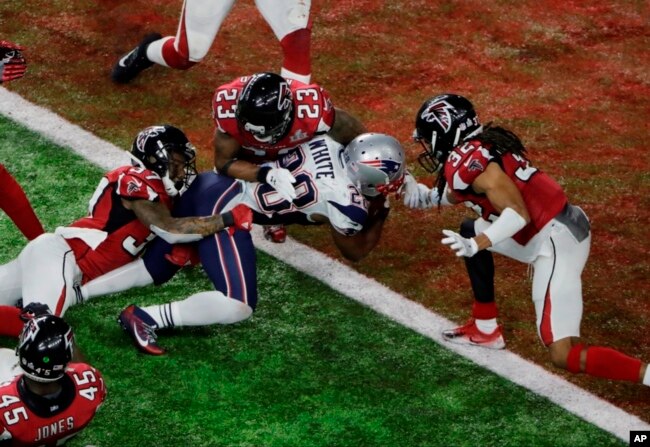
At one point, the Patriots were losing to the Falcons 28-3. The game seemed over. But the Patriots came back to win in overtime, 34-28. Running back James White dove over the goal line to score the winning touchdown.
Names from this year’s Super Bowl took over Twitter and Facebook in the United States from Sunday evening into Monday.
New England quarterback Tom Brady was named the game’s Most Valuable Player. He became the first quarterback in the National Football League to win five Super Bowls.
James White scores the winning touchdown for New England.
One writer said he played the best Super Bowl game ever.
The Falcons looked so good in the first half of the game that many people turned away from the game itself.
That set the stage for the halftime show. Lady Gaga’s 13-minute show got better ratings than the game did.
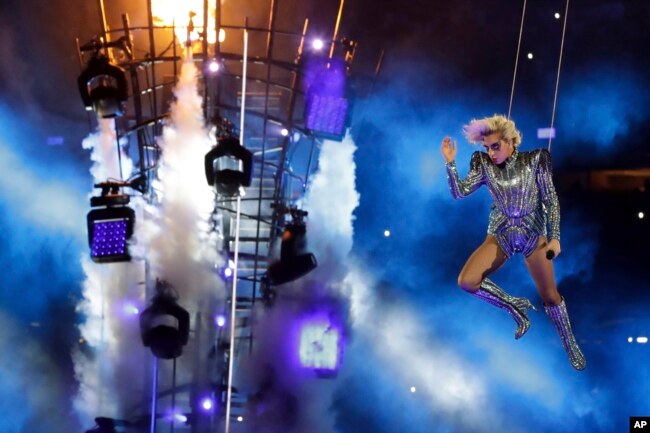
Lady Gaga arrives for her performance at the Super Bowl.
Lady Gaga wore a beaded, silver costume, including high-heeled silver boots. She had sparkling makeup around her eyes. She was lowered onto the stage with wires from high above the stadium.
She performed seven of her popular songs, including “Poker Face,” “Bad Romance,” “Just Dance” and “Born This Way.”
She was joined on stage by many dancers but no guest performers.
After the game, Lady Gaga announced her plans for a series of performances around the world. The tour starts in Canada on August 1 and takes her to the United States, Brazil, Switzerland, England, Spain, Sweden and several other countries.
One expert said it was the fourth-straight year that more people watched the halftime show than the football game itself.
Television commercials also trended on social media. One of the most talked-about commercials came from the building supply company 84 Lumber.

That advertisement showed a mother and daughter walking through the desert towards the United States, only to be stopped at the border by a wall. They believe their trip is over, but find a door that lets them through.
The commercial ends with the words: “The will to succeed is always welcome here.”
And that’s What’s Trending Today.
I’m Dan Friedell.
_______________________________________________________________

Words in This Story

overtime – n. extra time added to a game when the score is tied at the end of the normal playing time
receiver – n. a player who catches passes thrown by the quarterback
quarterback – n. a player who leads a team's attempts to score usually by passing the ball to other players
costume – n. the clothes that are worn by someone (such as an actor) who is trying to look like a different person or thing
halftime – n. the period of rest between the end of the first half and the beginning of the second half in games like football and basketball
set the stage – expression. to make something likely or ready to happen
sparkling– adj. shining with or reflecting bright points of light
wire – n. a thin, flexible thread of metal
beaded adj. decorated or covered with beads; bead: a small, usually round piece of glass, wood, stone, etc., that has a hole through its center and that is put on a string with other similar pieces and worn as jewelry or that is sewn onto clothing
tour – n. a series of related performances, appearances, competitions, etc., that occur at different places over a period of time
will – n. a strong desire or determination to do something
running back – n. a player who carries the football on running plays

English In The News: Missile System in South Korea Meant to Stop North Korean Threat

China is increasing efforts to stop deployment of an American anti-missile system on the Korean Peninsula.
The missile system is called THAAD, short for the Terminal High Altitude Area Defense System.
The deployment is one of several issues being discussed by South Korean and United States officials.
U.S. Defense Secretary James Mattis arrived in Seoul Thursday on his first foreign trip as head of the Defense Department.
Mattis spoke with South Korean Prime Minister Hwang Kyo-ahn. He restated the U.S. desire for strong cooperation with South Korea as it faces possible threats from North Korea.
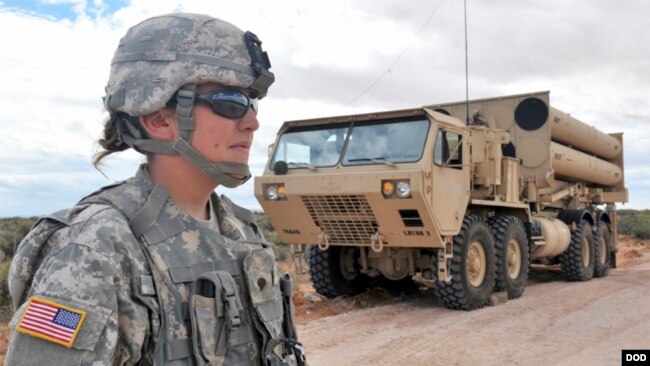
A U.S. soldier guards a part of the THAAD missle system.
The defense secretary said America stands “shoulder-to-shoulder” with South Korea. He added that, “Were it not for the provocative behavior of North Korea, we would have no need for THAAD out here.”
Other nations do not need to be worried about THAAD, he said.
After visiting South Korea, Mattis planned to visit Japan, another U.S. ally in East Asia.
U.S. and South Korean officials have repeatedly stated that the aim of the missile system is to answer the threat of North Korean missile attacks on the South.
China, however, considers the planned deployment as a threat to its security.
The deployment comes at a time when there are several difficult issues facing China and the United States.
One is China’s territorial claims in the South China Sea. But defense experts say North Korea’s nuclear and missile programs could likely be the biggest security problem facing the U.S. over the next two years.
On January 1, North Korean leader Kim Jong Un announced that his country is close to launching an intercontinental ballistic missile.
North Korea continues work on both its nuclear and missile programs, yet faces strong trade restrictions because of those activities.
U.S. officials, including President Donald Trump, have criticized China for not doing more to control its neighbor.
China has concerns about THAAD deployment
China, however, objects to the anti-missile system being placed so near its borders.
THAAD has a powerful radar system that China says would let the United States see far into Chinese and Russian territory.
Tang Jianqun is director of the department of American Studies at the China Institute of International Studies. He says there are two things about the system that worry China.
“This is not only a military system for the ROK [Republic of Korea]. This is actually a regional, a global plan, for the United States to have a shield in one hand and a sword in another,” he said.
Tang added that the THAAD system interferes with the balance of power among states that possess nuclear weapons. He said THAAD is part of a chain” of systems that goes from Europe to East Asia and the Pacific.
Tang said the Chinese government is concerned about U.S. radars in Japan, Alaska and on the island of Taiwan. This larger system is what China objects to, he said.
Some experts say China also is worried that the deployment will hurt its efforts to expand influence in South Korea. The two countries have strong trade ties.
And in 2015, the South Korean and Russian leaders visited China for a military parade marking the 70th anniversary of the end of World War II.
Since that time, however, South Korean President Park Gyuen-hye agreed to the deployment of THAAD. Later, Park was impeached on corruption charges. The country’s highest court is now considering the case.
China may have taken steps to show displeasure with the THAAD deployment. Jagannath Panda, an expert with the Institute of Defense Studies and Analysis in New Delhi, notes a drop in the number of Chinese making visits to South Korea. He says this has affected the South Korean economy.
South Korean media have reported on other actions they say China has taken since the deployment was announced. These include travel restrictions on Korean performers, cancellation of some private charter flights and actions against a South Korean business, the Lotte Group.
Lotte is one of South Korea’s biggest conglomerates. It owns the property where THAAD is to be set up.
The anti-missile system is expected to be put in place in May. However, there are concerns that growing public opposition may delay the deployment.
I’m Mario Ritter.
_____________________________________________________________

Words in This Story

shoulder-to-shoulder – idiom in cooperation with, working together closely
provocative – adj. causing discussion, or argument
impeach – v. to charge a public officials with a crime
conglomerate – adj. a large business composed of many different kinds of companies
intercontinental – adj. extending among continents; carried between continents
ballistic – adj. of or related to the movement of objects in flight

English In The News: Why Some Worry About Trump’s Tweets

By early Friday morning, President Donald Trump was back on Twitter. He tweeted about U.S. relations with Iran and Australia, “radical Islamic terrorist” and “Yes, Arnold Schwarzenegger.”
Just the day before, the president had already tweeted that “Iran has been formally PUT ON NOTICE for firing a ballistic missile.” And he questioned if government financial aid should stop for a California university where protestors prevented a Breibart News editor from speaking.
Trump, entering his third week as president, is tweeting often – just as he did during his successful campaign for president.
Why some are concerned about his tweets
His frequent postings on Twitter are raising questions. Some want the White House to keep all of Trump’s tweets as part of the official administration records to be turned over after he leaves office. Others worry his Twitter account can be “hacked,” while some question if his tweets will make it difficult for him to govern.
Shontavia Johnson is director of the Intellectual Property Law Center at Drake University Law School in Iowa.
Johnson said some might ask “what’s the big deal” saving Trump’s tweets for presidential records. But she said it is important the White House keep all tweets so National Archives and Records Administration experts can organize them for study by historians after Trump’s presidency ends.
Concern about hacking
Chris Dore is a Chicago lawyer who works on privacy and technology issues. Dore said he worries people will hack into Trump’s Twitter account and post fake material.
“Twitter accounts get hacked all the time,” Dore said. If people got a hold of Trump’s Twitter account, they could pass on false information about a business, or create an international crisis, so they could gain financially, he said.
Already tweets from the @realDonaldTrump have affected the price of stocks. The Wall Street Journal reported that, after Trump criticized companies such as Lockheed Martin, Boeing, Ford, General Motors and Toyota, their stock prices dropped.
Trump aide says president wants to connect with people
Kellyanne Conway is a Trump adviser. She said Trump continues to tweet because it is “a very powerful way for him to communicate and connect directly with people.”
But Trump’s tweets have not always helped him. On Tuesday, Trump’s spokesman Sean Spicer talked about the president's order temporarily blocking travel to the U.S. from seven majority-Muslim nations. Spicer said news reports were wrong to call it a travel ban. Reporters noted that Trump himself had called it a ban just the day before on Twitter.
Using Twitter to hit back at critics
As he did as a presidential candidate, Trump uses Twitter to hit back at people and organizations he believes have been unfairly critical. He accused Senate Democratic Leader Chuck Schumer of showing “fake tears” to criticize Trump's travel restrictions. And he continues to attack news organizations, saying they are dishonest and providing "fake news."
Theodore Glasser is a professor of communications at Stanford University in California. During a recent talk on Trump’s relations with the news media, he complained that Trump is not always truthful in his tweets and statements.
“There is no commitment to ‘facts’ or ‘truth,” he said. Glasser said Trump has done “more damage to the quality of public discourse than any president I can remember.”
Carole Bell is a communications expert at Northeastern University in Boston, Massachusetts. She said Trump supporters enjoy reading tweets directly from Trump on how he feels about issues and his critics. It gives him “authenticity,” she said.
But Bell said Trump is bringing that same “informality” to more formal settings. She cited speeches at the National Prayer Breakfast and for Black History Month that drew questions whether he was taking the events seriously enough.
John Wihbey, another Northeastern University communications expert, said tweeting helped Trump win over voters during the election. But Wihbey said tweeting his opinions in 140 characters or less as president might not be helpful as he tries to govern and negotiate health and tax bills, or new international trade deals.
I'm Bruce Alpert. And I'm Anne Ball.
______________________________________________________________

Words in This Story

formally – adv. made or done in an official and usually public way
ballistic missile – n. a weapon that is shot through the sky over a great distance and then falls to the ground and explodes
editor – n. a person whose job is to prepare (something written) to be published or used: an editor can make changes, correct mistakes, etc., in (something written)
frequent – adj.​ happening often
account – n.​ an arrangement in which a person uses the Internet or e-mail services of a particular company​
hack – v. to secretly get access to the files on a computer or network in order to get information or cause damage
fake – adj. not real
stock – n. share of the value of a company which can be bought, sold, or traded as an investment
complain – v.​ to say (something that expresses dislike or unhappiness)​
commitment – n. a promise to do or give something
discourse – n.​ a long talk or piece of writing about a subject​
authenticity – adj. real or genuine
cite – v. to mention (something) especially as an example or to support an idea or opinion​