“Twenty years from now you will be more disappointed by the things that you didn't do than by the ones you did do. So throw off the bowlines. Sail away from the safe harbor. Catch the trade winds in your sails. Explore. Dream. Discover.”
― H. Jackson Brown Jr., P.S. I Love You
Sometimes we all lose inspiration to achieve goals, succeed in our everyday lives and work, and think creatively. Whether you are an artist that wants to produce more creative work; a person with a specific goal in work, education, or fitness; or simply someone who wants to regain enthusiasm for life, learn to get back in touch with the well of inspiration present in all of us..
Most college students would love to get an assignment like the one Madeline Ota recently received at Stanford University.
She and her classmates were asked to make beer in their dorm rooms.
But before you get too excited, you need to know that it was for a class called The Archaeology of Food. And the assignment was to make beer according to a 5,000-year-old Chinese recipe.
“I think it was a bit different than beers that you would buy in the store because it only had a week to ferment, and I think that is one of the biggest differences that you would notice in taste. Because after only a week, alcoholic content isn’t very strong.”
Ota and her classmates made two kinds of ancient beer, some of which are still being made by indigenous people today. One of the beers was made by grinding grains like wheat, millet or barley.
The other was made using a root known as manioc, or cassava, in different parts of the world. The students chewed the root and then spit it into glass containers. Their saliva began the fermentation process.
Water and heat were carefully added to each mixture.
Ota said she has a new appreciation for what goes into making the beer people buy at stores or at the local bar.
“This is not something we should take for granted when we go and pick up something from the store. And you know, that doesn’t just apply to beer, but kind of any sort of processed food. There is a whole story behind how this got to where it is, how people produced it, how they cooked it...”
Their professor, Li Liu, discovered the old Chinese recipe.
Liu and a graduate student, Jiajing Wang, “reverse engineered” their beer recipe based on substances found in clay pots from northeast China. That means they studied the residue and made guesses as to what the original ingredients might have been.
The researchers found evidence of barley, an important grain in making beer today. Until Liu and Wang did their research, most historians thought barley arrived in China more recently.
A close-up shot of the beer Stanford students recently made following an ancient Chinese recipe.
“Again, that’s where experimental archaeology comes in. Because when you have this small residue from an archaeological artifact, you know, you don’t have the full story. You may have parts of a bigger story, but you don’t know how those parts necessarily fit together. So experimental archaeology is really cool because it allows you to experiment with those processes and see which ones are the most successful.”
Ota said we can learn a lot about ancient cultures by learning about their food and beer.
“You know, when the first people started actually having farms and agricultural societies, very soon after that they actually started making the first alcohols using various techniques. Having alcohol became a very culturally significant and religious experience for many communities and it went on to become an important part of their society.”
Because the class treated the beer making like a science project, they were able to add their information to the scientific record. Every ingredient was carefully measured. Every degree of heat was noted.
Thanks to the students, there is now a very specific record for how to make these ancient beers. In the past, the instructions might have been “fill the pot with water,” Ota said. But no one ever knew how big the pot was or how much water was used.
But the most important question is: How did the beer taste?
The beer made from grain, Ota said, was fruity, like a cider. The one from manioc root smelled so bad – like cheese – she didn’t want to try it.
I’m Dan Friedell.
Words in This Story
assignment– n. a job or duty that is given to someone : a task someone is required to do
dorm – n. a building on a school campus that has rooms where students can live
archaeology – n. a science that deals with past human life and activities by studying the bones, tools, etc., of ancient people
ferment – v. to go through a chemical change that results in the production of alcohol
take for granted – v. to fail to properly notice or appreciate (someone or something that is helpful or important to you)
residue – n. a usually small amount of something that remains after a process has been completed or a thing has been removed
artifact – n. a simple object (such as a tool or weapon) that was made by people in the past
cool – adj. often used to show approval in a general way
cider – n. an alcoholic drink made from apples
bar – n. a building or room where alcoholic drinks and sometimes food are served
reverse engineer – v. to study the parts of (something) to see how it was made and how it works so that you can make something that is like it
America’s most expensive home is for sale in Los Angeles, California for $250 million.
The new 12,000-square-meter home has 12 bedrooms and 21 bathrooms. The home also has three kitchens, a 25-meter swimming pool, a 40-seat movie theater, spa and bowling alley. It has an elevator to take people up and down four floors.
The bowling alley is shown inside America’s most expensive home, which is for sale in the Bel Air neighborhood of Los Angeles, California, for $250 million. (Bruce Makowsky / BAM Luxury Development)
The home sits on a hill in the Bel Air neighborhood, a favorite living area for movie stars and other famous people. It has great views of the city, mountains and ocean.
American developer Bruce Makowsky built the house. He said only about 3,000 people in the world have enough money to buy it.
The pool with a view is shown as part of America’s most expensive home, which is for sale in the Bel Air neighborhood of Los Angeles, California, for $250 million. (Bruce Makowsky / BAM Luxury Development)
But what makes this home different from the many other expensive ones in Los Angeles? It also comes furnished with many built-in luxuries.
A collection of luxury cars is included for the buyer of America’s most expensive home, which is for sale in the Bel Air neighborhood of Los Angeles, California, for $250 million. (Bruce Makowsky / BAM Luxury Development)
The buyer gets $30 million worth of expensive cars and motorcycles, including a Rolls-Royce, a Ferrari and a Bugatti.
The home also includes many furnishings and art pieces created by well-known designers and artists.
The lounge is shown inside America’s most expensive home, which is for sale in the Bel Air neighborhood of Los Angeles, California, for $250 million. (Bruce Makowsky / BAM Luxury Development)
Included in the price are seven full-time workers who live in a separate part of the home.
Makowsky says people who visit the home quickly run out of words to describe it. “Every single thing in this house makes you feel like you’re in heaven,” he told the Associated Press.
The deck is shown outside America’s most expensive home, which is for sale in the Bel Air neighborhood of Los Angeles, California, for $250 million. (Bruce Makowsky / BAM Luxury Development)
He does not think the $250-million price is too high. He said the right person will be willing to pay for the luxury it provides, rather than just watching their billions of dollars sit in the bank.
“It’s the kind of thing where I can’t sell it," he said. "Somebody has to fall in love with it, and die over it.”
The helicopter is shown outside a window of America’s most expensive home, which is for sale in the Bel Air neighborhood of Los Angeles, California, for $250 million. (Bruce Makowsky / BAM Luxury Development)
One of the most unusual parts of the home is a helicopter sitting on the roof. But the helicopter – an old model used on an American television show in the 1980s – is just for show. Even for $250 million, you cannot buy takeoff and landing rights.
In northern India, an increasing number of young women are learning to compete in the sport of wrestling.
Until recently, few girls and women trained for wrestling in the northern state of Haryana. The area has a strongly patriarchal culture. Men there appear to be in control of the government and much of society.
But after many female wrestlers were successful in international competitions, ideas about women in Haryana began to change.
On a cold winter morning, a group of young girls and women are preparing for three hours of training at the Chottu Ram Stadium, a sports center in the town of Rohtak.
Meenakshi, who uses just one name, is 12 years old. She starts her training at 6 in the morning, before school begins. She and other female wrestlers look up to Sakshi Malik, who trained at the stadium. Malik won a bronze medal at the 2016 Olympic Games in Rio de Janeiro.
Meenakshi notes that Malik’s short wrestling match made her famous throughout the country.
“Only nine seconds she made her life wonderful, completely.”
Many people in Haryana state did not, and still do not, support the idea of women competing in the sport. Men control many of the state’s village councils. And many local women who are pregnant with girls end their pregnancies because they want to have sons. But ideas about women began to change after two women wrestlers performed well at the 2010 Commonwealth Games.
Mandeep supervises training for women and men, girls and boys. Like Meenakshi, he uses just one name. He says that when he came to the stadium six years ago, only a few girls wanted to become wrestlers. Now, he says, many parents want their daughters to train in the sport.
“Earlier, parents stopped the girls (from training in wrestling) and kept them at home because that was the social norm. Now, parents are supporting them in fulfilling their ambitions. It’s a huge social change."
Many of the young women training to become wrestlers live in villages where women’s bodies are often completely covered and where girls cannot mix with boys. The young women include 17-year-old Tina Malik, who has won a national medal in wrestling.
“Earlier, even for practice we could not wear clothes like this. Now we can wear this sports gear -- no one objects.”
Pinki Malik won a gold medal at the 2016 Commonwealth Championship. She hopes to win a medal at the next Olympics. But she says awards are not the only reason she competes.
“Women should get respect. That is the biggest issue -- respect. Wrestling will improve things for us.”
As their success changes people’s opinions, wrestling has become one way for Haryana’s girls and women to create their own future.
patriarch – n. a man who controls a family, group, or government
stadium – n. a very large usually roofless building that has a large open area surrounded by many rows of seats and that is used for sports events, concerts, etc.
inspire – v. to make (someone) want to do something; to give (someone) an idea about what to do or create
norm – n. standards of proper or acceptable behavior
fulfill – v. to succeed in achieving (something); to make (something, such as a dream) true or real
ambition – n. a particular goal or aim; something that a person hopes to do or achieve
medal – n. a piece of metal often in the form of a coin with designs and words in honor of a special event, a person or an achievement
gear – n. supplies, tools or clothes needed for a special purpose
object – v. to disagree with something or oppose something
These days, shopping often involves an Internet connection and a laptop or smartphone. However, businesses are now trying to use new technology, such as 3Dprinting and augmented reality, to bring customers back into stores.
At the recent National Retail Federation show in New York City, many companies demonstrated these new technologies. One, the computer company Intel, is experimenting with 3D printing. It is using the Mach 2XS commercial printer.
Instead of printing words on paper, the Mach 2XS prints clothes. For example, it uses thread to print out a sweater. It prints the sweater out row by row, until it is fully formed.
Ryan Parker is the general manager of Responsive Retail at Intel. He says the 3D printers print out clothing, made just for the individual in size and style, in about 45 minutes.
Bringing consumers back to stores
More and more consumers shop online. But young people still seem to like going to physical stores. A recent study shows that 67 percent of people between ages 13 to 21 shop in physical stores most of the time. The IBM Institute for Business Value and the National Retail Federation did the study.
A London-based company, Ads Reality, is trying to use augmented-reality, or AR technology in stores. Augmented reality is a technology that creates computer-generated images and projects them in a way that they look real.
“When it’s used in the right way, it’s a very powerful tool to drive mobile engagement and store traffic,” said Richard Corps, managing director.
The company’s latest product is an “AR Window.” It superimposes life-sized augmented-reality characters on big screens in store windows.
“It looks like those characters are actually inside the store ... it stops people outside the store because they’re amazed to see these characters ... and then it drives them inside the store because they want to have their photograph taken with these characters,” Corps said.
Customer service robots
Customer service robots might also become a common store experience. The New York company Autonomous is experimenting with customer service robots. These wheeled devices include a Wi-Fi connection to a real person who can be seen on the robot’s screen.
Robots in a hardware store, for example, could be operated from anywhere by experts in different fields, like plumbing or electrical wiring.
Autonomous chief Duy Huynh says the robots can make the shopping experience personal.
“With our technology, when you walk into a store one of our robots will approach you and behind the robot, [it’s] going to bring someone who knows your shopping habits, who has been helping you for the past six months, who knows what you need, to talk to you. So to us that’s really, really important and that’s the very first time you can actually do personalization offline.”
The New England Patriots football team defeated the Atlanta Falcons in the 51st Super Bowl on Sunday. It was the Patriots’ fifth Super Bowl win.
It was also the first-ever Super Bowl game to go into overtime.
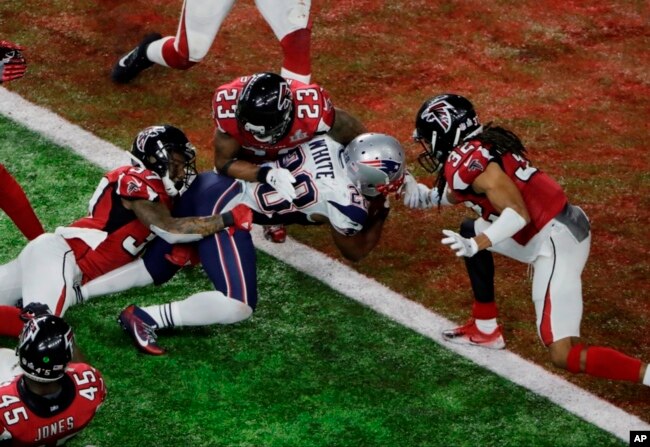
At one point, the Patriots were losing to the Falcons 28-3. The game seemed over. But the Patriots came back to win in overtime, 34-28. Running back James White dove over the goal line to score the winning touchdown.
Names from this year’s Super Bowl took over Twitter and Facebook in the United States from Sunday evening into Monday.
New England quarterback Tom Brady was named the game’s Most Valuable Player. He became the first quarterback in the National Football League to win five Super Bowls.
James White scores the winning touchdown for New England.
One writer said he played the best Super Bowl game ever.
The Falcons looked so good in the first half of the game that many people turned away from the game itself.
That set the stage for the halftime show. Lady Gaga’s 13-minute show got better ratings than the game did.
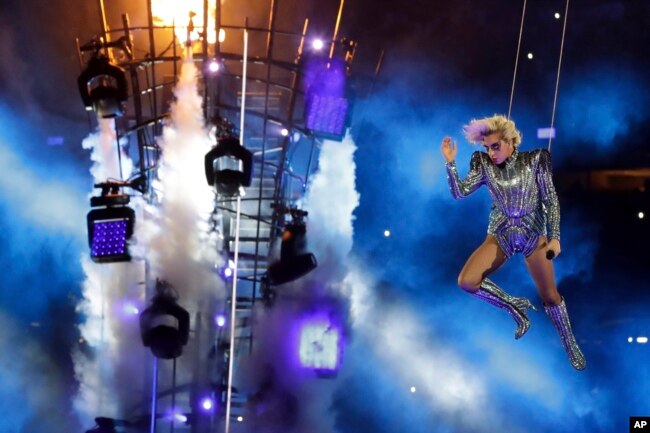
Lady Gaga arrives for her performance at the Super Bowl.
Lady Gaga wore a beaded, silver costume, including high-heeled silver boots. She had sparkling makeup around her eyes. She was lowered onto the stage with wires from high above the stadium.
She performed seven of her popular songs, including “Poker Face,” “Bad Romance,” “Just Dance” and “Born This Way.”
She was joined on stage by many dancers but no guest performers.
After the game, Lady Gaga announced her plans for a series of performances around the world. The tour starts in Canada on August 1 and takes her to the United States, Brazil, Switzerland, England, Spain, Sweden and several other countries.
One expert said it was the fourth-straight year that more people watched the halftime show than the football game itself.
Television commercials also trended on social media. One of the most talked-about commercials came from the building supply company 84 Lumber.
That advertisement showed a mother and daughter walking through the desert towards the United States, only to be stopped at the border by a wall. They believe their trip is over, but find a door that lets them through.
The commercial ends with the words: “The will to succeed is always welcome here.”
overtime – n. extra time added to a game when the score is tied at the end of the normal playing time
receiver – n. a player who catches passes thrown by the quarterback
quarterback – n. a player who leads a team's attempts to score usually by passing the ball to other players
costume – n. the clothes that are worn by someone (such as an actor) who is trying to look like a different person or thing
halftime – n. the period of rest between the end of the first half and the beginning of the second half in games like football and basketball
set the stage – expression. to make something likely or ready to happen
sparkling– adj. shining with or reflecting bright points of light
wire – n. a thin, flexible thread of metal
beaded - adj. decorated or covered with beads; bead: a small, usually round piece of glass, wood, stone, etc., that has a hole through its center and that is put on a string with other similar pieces and worn as jewelry or that is sewn onto clothing
tour – n. a series of related performances, appearances, competitions, etc., that occur at different places over a period of time
will – n. a strong desire or determination to do something
running back – n. a player who carries the football on running plays
During his visit to Asia, U.S. Defense Secretary Jim Mattis said the U.S. is committed to “freedom of navigation” in the disputed waters in the South China Sea. But, he ruled out a military response.
Mattis said to reporters in Tokyo, “At this time, we do not see any need for dramatic military moves at all.”
Tension between U.S. and China
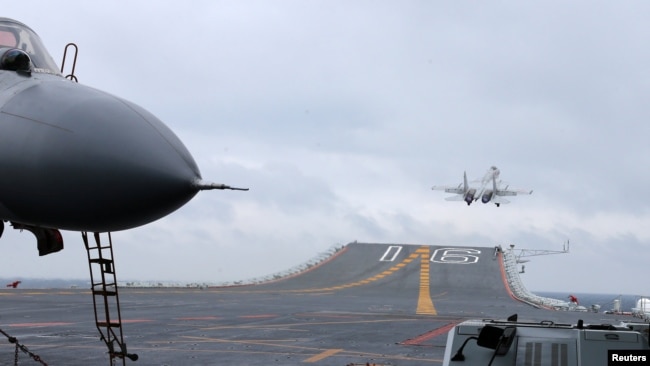
Last December, China conducted takeoff and landing drills from its aircraft carrier Liaoning in the South China Sea, according to the state news agency Xinhua. The move followed a phone call between then President-elect Donald Trump and the president of Taiwan. China has long considered Taiwan as a province of China.
J-15 fighters from China's Liaoning aircraft carrier conduct a drill in an area of the South China Sea, on Jan. 2, 2017.
During his confirmation hearing, Rex Tillerson, the new U.S. Secretary of State, called China’s island building an “illegal” activity.Hesaid, “We’re going to have to send China a clear signal that, first, the island-building stops; and, second, your access to those islands also is not going to be allowed.”
The comment drew sharp reaction from China. Lu Kang is a spokesman for China’s Foreign Ministry. In his daily briefing on Jan. 12, he said that China “has full right to conduct any kind of normal activities on its own territory within its sovereignty.”
The Global Times is a state-run news organization. It published a strongly worded editorial saying, “Unless Washington plans to wage a large-scale war in the South China Sea, any other approaches to prevent Chinese access to the islands will be foolish.”
China’s military capabilities
Military experts say China’s current military capabilities do not measure up to Beijing’s tough rhetoric on its continuing activities in the South China Sea.
“Certainly things are more tense than they were just a few weeks ago. But I still don’t think we’re quite at the point of crisis, and certainly not at immediate confrontation.”
Engstrom said China’s navy is not nearly as well equipped as the United States.
The Liaoning is the only aircraft carrier in the Chinese naval fleet. It was first built for the Soviet navy and launched in Ukraine in 1988, but was never fully completed. It was upgraded and modernized for the People’s Liberation Army (PLA) Navy, which launched it in 2012.
The Liaoning is smaller than U.S. aircraft carriers and cannot support as many aircraft. It also has a “ski jump” type of system for launching aircraft instead of a catapult system. This limits the size of aircraft that can be launched, as well as how many weapons can be loaded onto the aircraft.
The U.S. Navy’s current Nimitz-class warships can handle more than 60 aircraft. One of these is the USS Ronald Reagan, stationed in Japan.
This image provided by the U.S. Navy shows the Nimitz-class aircraft carrier, USS Ronald Reagan underway in the Pacific Ocean Saturday March 12, 2011 enroute to Japan to render humanitarian assistance and disaster relief. (AP Photo/US Navy - Dylan McCord)
Since the Liaoning has only been fully operational for a few years, it also remains behind the U.S. Navy in experience and training.
Denny Roy is a senior fellow at the Hawaii-based East-West Center. He says China is getting a lot of experience using the Liaoning while building its own new carrier fleet.
“We understand that the Liaoning is primarily meant for training. Learning to operate an aircraft carrier takes many years, it’s extremely complicated. So it’s reasonable that the Chinese would start with a practice carrier, with the training wheels.”
Roy added that China is thought to be currently working on additional, more advanced aircraft carriers.
“We think there are more Chinese carriers under construction that will be larger, more capable - and these are intended to actually be prepared to fight.”
However, he added that even China’s carriers currently under construction will not have the same capacity as the new U.S. super carriers.
The United States is currently building a new class of aircraft carriers known as the Gerald R. Ford class. These $13 billion super carriers are even bigger than the Nimitz class. They can carry more than 4,500 people and at least 75 aircraft. The first of these, the USS Gerald Ford, is expected to be put into service in 2017.
Jeffrey Engstrom says despite the Liaoning’s limited capabilities, it serves as an important symbol of progress for China’s navy.
“The symbolism is that China is a great power. Great powers have aircraft carriers, and China too has an aircraft carrier.”