


China is increasing efforts to stop deployment of an American anti-missile system on the Korean Peninsula.
The missile system is called THAAD, short for the Terminal High Altitude Area Defense System.
The deployment is one of several issues being discussed by South Korean and United States officials.
U.S. Defense Secretary James Mattis arrived in Seoul Thursday on his first foreign trip as head of the Defense Department.
Mattis spoke with South Korean Prime Minister Hwang Kyo-ahn. He restated the U.S. desire for strong cooperation with South Korea as it faces possible threats from North Korea.
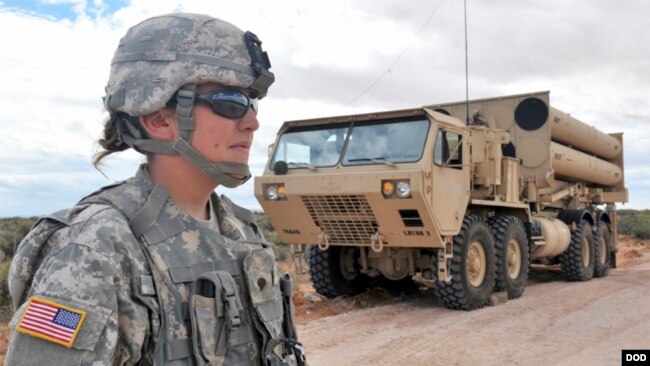
A U.S. soldier guards a part of the THAAD missle system.
The defense secretary said America stands “shoulder-to-shoulder” with South Korea. He added that, “Were it not for the provocative behavior of North Korea, we would have no need for THAAD out here.”
Other nations do not need to be worried about THAAD, he said.
After visiting South Korea, Mattis planned to visit Japan, another U.S. ally in East Asia.
U.S. and South Korean officials have repeatedly stated that the aim of the missile system is to answer the threat of North Korean missile attacks on the South.
China, however, considers the planned deployment as a threat to its security.
The deployment comes at a time when there are several difficult issues facing China and the United States.
One is China’s territorial claims in the South China Sea. But defense experts say North Korea’s nuclear and missile programs could likely be the biggest security problem facing the U.S. over the next two years.
On January 1, North Korean leader Kim Jong Un announced that his country is close to launching an intercontinental ballistic missile.
North Korea continues work on both its nuclear and missile programs, yet faces strong trade restrictions because of those activities.
U.S. officials, including President Donald Trump, have criticized China for not doing more to control its neighbor.
China has concerns about THAAD deployment
China, however, objects to the anti-missile system being placed so near its borders.
THAAD has a powerful radar system that China says would let the United States see far into Chinese and Russian territory.
Tang Jianqun is director of the department of American Studies at the China Institute of International Studies. He says there are two things about the system that worry China.
“This is not only a military system for the ROK [Republic of Korea]. This is actually a regional, a global plan, for the United States to have a shield in one hand and a sword in another,” he said.
Tang added that the THAAD system interferes with the balance of power among states that possess nuclear weapons. He said THAAD is part of a chain” of systems that goes from Europe to East Asia and the Pacific.
Tang said the Chinese government is concerned about U.S. radars in Japan, Alaska and on the island of Taiwan. This larger system is what China objects to, he said.
Some experts say China also is worried that the deployment will hurt its efforts to expand influence in South Korea. The two countries have strong trade ties.
And in 2015, the South Korean and Russian leaders visited China for a military parade marking the 70th anniversary of the end of World War II.
Since that time, however, South Korean President Park Gyuen-hye agreed to the deployment of THAAD. Later, Park was impeached on corruption charges. The country’s highest court is now considering the case.
China may have taken steps to show displeasure with the THAAD deployment. Jagannath Panda, an expert with the Institute of Defense Studies and Analysis in New Delhi, notes a drop in the number of Chinese making visits to South Korea. He says this has affected the South Korean economy.
South Korean media have reported on other actions they say China has taken since the deployment was announced. These include travel restrictions on Korean performers, cancellation of some private charter flights and actions against a South Korean business, the Lotte Group.
Lotte is one of South Korea’s biggest conglomerates. It owns the property where THAAD is to be set up.
The anti-missile system is expected to be put in place in May. However, there are concerns that growing public opposition may delay the deployment.
I’m Mario Ritter.
_____________________________________________________________
Words in This Story
shoulder-to-shoulder – idiom in cooperation with, working together closely
provocative – adj. causing discussion, or argument
impeach – v. to charge a public officials with a crime
conglomerate – adj. a large business composed of many different kinds of companies
intercontinental – adj. extending among continents; carried between continents
ballistic – adj. of or related to the movement of objects in flight


