Showing posts with label Donald Trump. Show all posts
Saturday, February 25, 2017
Undocumented US Immigrants Fear Deportation
Cindy lives with her three children in a small bedroom in an apartment near a major American city. Two other adults also live in the apartment.
Cindy asked VOA to use just her first name for this story. She is not in the United States legally. She was born in Guatemala and brought to the United States when she was five years old.
So, Cindy considers the U.S. home.
“Even though I don’t have papers, I feel that I’m from here. Of course, I’m proud of having been born in Guatemala, but I wasn’t raised there. I don’t know the culture over there. I don’t know what it’s like to live there.”
She has worked since she was 17, holding different jobs. She is now 29 and pregnant. Cindy says she wants to stay in the United States so she and her family can have a good life. Her children were born in the United States, so they are citizens. Cindy says she is more scared than she has ever been of being deported to Guatemala. She says she wants to become a legal resident of the United States.
Cindy is among an estimated 11 million people living in the United States without government permission. Experts say more than half of them are from Mexico and other Latin American countries.
Last week, the Immigration and Customs Enforcement (ICE) agency, part of the Department of Homeland Security, carried out raids around the country. They arrested 680 people. The agency said it was targeting people who had been found guilty of crimes while in the United States. ICE said the raids were no different than those that took place during the Obama administration.
In a statement this week, Homeland Security Secretary John Kelly said “President Trump has been clear in affirming the critical mission of DHS in protecting the nation, and directed our department to focus on removing illegal aliens who have violated our immigration laws.”
Trump promised often during the campaign to stop illegal immigration. He said if he became president he would deport up to three million people involved in criminal activity. On January 25th, he signed a presidential order that expanded the powers of ICE to detain immigrants.
On Sunday, Trump wrote a message on the social networking site Twitter. He said “The crackdown on illegal criminals is merely the keeping of my campaign promise. Gang members, drug dealers (and) others are being removed!”
His message seemed to differ from what ICE said about its actions: that they were usual -- no different from what the agency did when Barack Obama was president.
The Department of Homeland Security said 25 percent of those arrested last week had not been found guilty of criminal acts in the United States but were in the country illegally. It said their cases will be examined individually. It said they may be deported even if they are not criminals.
Angelica Satas is the executive director of the Coalition for Humane Immigrant Rights of Los Angeles. She said she has been watching the operations of ICE for 30 years. She said last week’s raids were “not normal.” She said many more people called her organization than usual while a raid was taking place in Los Angeles. She said some people were being seized in their homes and as they traveled to their jobs.
Many immigrants are afraid. There are reports that ICE will be setting up checkpoint stations to stop and seize immigrants who entered the United States without permission.
Many people from Latin America live in the Columbia Heights area of Washington, DC. VOA spoke with some of them as they waited at a Catholic Charities center for free food. They said they feared being deported.
Rodrigo Aguirre works at Catholic Charities. He says he has noticed a difference from a year ago.
"We're seeing people just become a little bit more afraid about asking for help. Because they are fearful of the consequences -- fearful that their name might be given to immigration and then eventually deported."
VOA spoke to a Salvadoran woman named Hemelina while she was waiting for free food from the center. She said she came to the United States illegally last year. She said she fled El Salvador because her husband often hit her and she feared gangs -- groups of criminals.
Smita Dazzo is an immigration lawyer for Catholic Charities. She says Hemelina could be given asylum if she can show a judge proof that she would be harmed if she is returned to El Salvador. Dazzo says most of the immigrants she talks to have what the law calls a well-founded fear of persecution in their home country.
“The majority of people that are coming here really are fleeing for their lives. It's, it's really, really scary for these people and some of them really honestly feel like they have no choice."
Dazzo says Trump’s election has caused many people in the U.S. illegally to begin the process of getting permission to stay.
But supporters of Trump’s immigration policy say limits are required because there are so many people who want to come to, or stay in, the U.S.
Dan Stein is among these voices. He heads the Federation for American Immigration Reform. He says that in the past 40 years the United States has had the highest level of immigration in its history. He says that cannot continue.
"All countries have to deal in the real world. And there are simply far more people who would like to move to a country like the United States than we can possibly handle and still provide a good quality of life and a shot at the American dream for people who are here today.”
It is not clear what will happen to the millions of people in the United States illegally who have not done a crime while they are here. They have families and jobs. Immigration activists say the solution is a law that lets them stay.
Dazzo says “there are a lot of people who come here as children that are really upstanding citizens. They work hard, they’re family oriented. They’re exactly what you hope that Americans are.”
I’m Christopher Jones-Cruise.
________________________________________________________
papers – expression immigration documents that show a person has permission to be in a country
deport – v. to force (a person who is not a citizen) to leave a country
resident – n. someone who lives in a particular place
affirm – v. to show a strong belief in or dedication to (something, such as an important idea)
critical – adj. extremely important
mission – n. a task or job that someone is given to do
focus – v. to direct your attention or effort at something specific (often + on)
crackdown – n. a serious attempt to punish people for doing something that is not allowed; an increased effort to enforce a law or rule
merely – adv. used to describe the only reason for something or the only effect of something
gang – n. a group of criminals
persecute – v. to treat (someone) cruelly or unfairly especially because of race or religious or political beliefs
handle – v. to do the work required for something; to deal with (a person, situation, etc.) successfully
upstanding – adj. honest and respectable
oriented – adj. designed to appeal to a certain kind of people; interested in a particular thing, activity, etc.
Friday, February 24, 2017
New Secretary of Education was Approved In to Donald Trump's cabinet
The United States Senate has narrowly approved Betsy DeVos to lead the federal Department of Education.
DeVos will join President Donald Trump’s new cabinet.
Cabinet members are among the president’s closest advisers. The president nominates them, but they need congressional approval before taking office.
As the secretary of education, DeVos will oversee the nation’s schools. She will also assist the president with education policy and legislation.
Controversial selection
If that job description sounds relatively simple, the path to DeVos’ congressional approval was not. She has been one of Trump’s most controversial cabinet choices – if not the most.
One reason is that DeVos says she wants to reduce the federal government’s involvement in education.
Historically, the federal government has played a major part in directing the nation’s public school system. Public schools are free for all students and have a fairly standard education curriculum.
About 100,000 primary and secondary schools nationwide are public. About 35,000 are private -- meaning students have to pay to attend classes.
DeVos says she would like to give more power over education to states and to parents.
At her confirmation hearing, she said she wants to move away from “what the system thinks is best for kids to what moms and dads want, expect and deserve.”
For example, instead of the local public school, some parents may want to send their child to a private same-sex school, one that provides training a certain foreign language, or one based on their religious beliefs. DeVos seeks to use public school money to support the choice.
Some supporters of DeVos say she will bring needed competition to public education. They say her vision for school choice will also give students from poor families the same opportunities as those from richer families.
Critics say DeVos’ plans will harm public schools and the students who depend on them – especially students in rural areas or those who have a disability.
Critics also point to her lack of firsthand experience of the public school system. DeVos did not attend public schools or send her children to them. She has also never been a teacher or school administrator.
Instead, she is a wealthy philanthropist, a major donor to members of Trump’s Republican Party, and a 30-year advocate for alternative choices to public education, especially Christian schools.
Vice president breaks tie
The controversy around DeVos’ confirmation was clear in Tuesday's vote. After arguing against DeVos on the Senate floor for 24 consecutive hours, all 48 Democrats opposed her, along with two Republicans from rural states. The other 50 Republicans supported her. The final vote was split, 50-50.
Fortunately, the U.S. Constitution has a way to deal with this problem. It says that if senators are “equally divided,” the vice president makes the deciding vote.
In this case, Vice President Mike Pence supported Trump’s choice and voted in favor of DeVos.
The Associate Press notes that the Senate historian says this is the first time a vice president has had to break a tie in a Cabinet nomination.
I’m Kelly Jean Kelly.
________________________________________________________________
Words in This Story
controversial – adj. relating to or causing much discussion, disagreement, or argument
curriculum – n. the courses that are taught by a school
deserve – v. used to say that someone or something should have
certain – adj. used to refer to something or someone that is not named specifically
opportunities – n. a situation in which something can be done
philanthropist – n. a wealthy person who gives money and time to help make life better for other people
alternative – adj. offering or expressing a choice
consecutive – adj. following each other without interruption
English Learning: Officials Consider the US-South Korea Free Trade Deal Relation In Trump's Emprise
Friday, February 24, 2017
Donald Trump, English Learning, Free Trade Deal, Trump's Twitter, tu moi tieng anh, Twitter blog, US-South Korea
No comments
American business leaders are urging South Korean leaders to increase market access to U.S. companies seeking to sell goods in South Korea.
The business leaders want to persuade U.S. President Donald Trump not to introduce policies that harm trade between the countries.
During the U.S. presidential campaign, Trump threatened to make changes to the bilateral free trade deal. The deal is known as the Korean U.S. Free Trade Agreement or KORUS FTA. Last year, Trump criticized the deal as “job killing.”
The American Chamber of Commerce in Korea, or AMCHAM Korea, wants to keep the current KORUS FTA. The agreement took effect in 2012.
The deal removed 95 percent of tariffs on consumer and industrial products over five years.
James Kim is Chairman of AMCHAM Korea. He said South Korea should consider ending some regulations on imports that hurt trade.
“We need to make the Korean economy more transparent and predictable, by making the regulatory process more deliberative,” Kim said recently in Seoul.
The American car industry, for example, has said it spends a lot of time and money on unneeded environmental rules. It also says it faces regulations that often are introduced without notice or explanation.
Fifteen percent of cars in South Korea are from foreign manufacturers. In other developed economies, such as the U.S. and European countries, foreign cars make up 40 percent of the market.
The American Automotive Policy Council says nearly 80 percent of the trade deficit with Korea is in automobile trade. That deficit was almost $28 billion in 2015.
Jeffrey Jones is a former AMCHAM Korea chairman. He says Trump’s statements on trade add urgency to efforts to take care of misunderstandings about trade practices. But, he says time is running out.
Supporters say KORUS agreement is working
AMCHAM Korea is sending a group to Washington, D.C., to defend the current trade agreement. The group wants to speak with lawmakers about how the trade deal is working.
South Korean officials say most problems have been solved through negotiations. They say the trade agreement also has helped the U.S. economy.
The Korea Automobile Manufacturers Association says U.S. car imports to South Korea have increased by 20 percent in two years.
AMCHAM Chairman Kim says one way to build support for the U.S.-Korea trade agreement is to show how American exports to South Korea have increased. U.S. exports to South Korea of all products and services have risen by 8 percent in the last 10 years.
Exports of some agricultural products have increased sharply since the free trade agreement has gone into effect.
Kim notes that several Korean companies, including carmakers Hyundai and Kia, have opened factories or offices in the U.S. The Korean companies have created more than 45,000 American jobs.
Recent news reports suggest that Samsung Electronics is considering opening a new manufacturing center in the U.S.
Trump wrote on Twitter, “Thank you, Samsung! We would love to have you!”
Thank you, @Samsung! We would love to have you! https://www.axios.com/trump-effect-samsung-may-build-u-s-factory-2233101986.html …
Samsung did not confirm that it would build a new factory. It did say, however, that it was making an investment of $17 billion in a semiconductor factory in Austin, Texas.
The trade agreement between the U.S. and South Korea is bilateral, meaning between two sides. It is unlike the huge 12-nation Trans-Pacific Partnership deal from which the U.S. withdrew, or the North American Free Trade Agreement, or NAFTA, which Trump has also criticized.
Korean companies with operations in Mexico, however, are concerned they could face increased tariffs if NAFTA is renegotiated. NAFTA covers trade among Mexico, Canada and the U.S.
I’m Mario Ritter.
________________________________________________________
Words in This Story
Consumer –adj. relating to goods and services bought by people
Regulations –n. rules or law about how something should be done
Predictable –adj. not unusual, happening in a way that can be foreseen
Deliberative –adj. doing something in a way that includes discussion of facts and thoughtful decision-making
Thursday, February 23, 2017
English In The News: Computer Data and the Business of Mind-Reading
Thursday, February 23, 2017
campaigns, campain trick, Clinton, computer data, Donald Trump, hoc tieng anh, polls, REading mind, social media stoles data, Voa News, voa report
No comments
Big data is having an increasing effect on the way we live.
Big data can be defined as information that is too big or complex to be contained or processed by any one machine or person. It can include which comments, photographs or stories you “like” on Facebook’s website.
It also includes seemingly harmless personal information that political campaigns use to reach voters.
The presidential election campaign of Donald Trump used big data to reach American voters who normally would not share their opinions with others. It also helped organizers of the campaign to end Britain’s membership in the European Union, known as Brexit.
Finding out more about people
John Kreisa works in London for Hortonworks, a computer software company that started in California. He says there are lots of ways to measure a person’s feelings.
“One probably very obvious one is things like Twitter,” he says. “Social media, in general, is a way that people express themselves and express a like or dislike...”
By themselves, the trillions of bits of information would just be a collection of countless facts, many of which are considered worthless. But add the power of the human mind and it is a different story.
As a student at the University of Sussex, Julian Dailly had two majors -- English and philosophy. When he completed his studies, Dailly wondered how he would ever earn a living in a world filled with machines and technology. Now, he is part of an industry that includes Google and Facebook. It is so large no one seems able to estimate its worth.

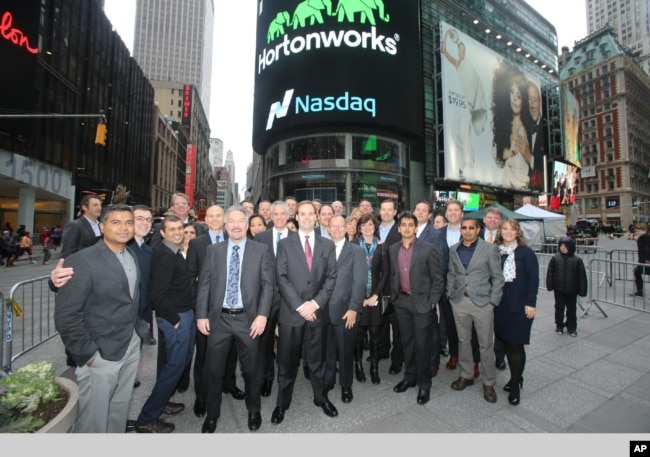
FILE - Hortonworks, Inc.Hortonworks, Inc., a California software company, opened for trading on The Nasdaq Stock Market, Dec. 12, 2014.
Predicting what people will do
Dailly’s research company, Morar Consulting, started three years ago with five employees. The company’s earnings have increased by 25 percent each year. It now employs 90 people.
“What we ultimately do here is we try to discover what’s meaningful for people and we correlate that to their economic behavior,” Dailly said.
He noted the importance of working with people with different skills.
“We have people from traditional research backgrounds, in addition to some in social sciences, economics, people from tech backgrounds, and sales people,” Dailly said.
Companies like Dailly’s employ recent college graduates. The industry profits from the ideas of these young men and women.
New forms of data also make it possible for some observers to predict the future. They are more valuable to companies and campaigns than the traditional forms of recordkeeping, recording, or reporting data.
“We have access to the core information inside people’s heads,” Dailly said. “They tell you what people are going to do as opposed to what they’ve done. That helps people take preemptive action. This makes it much more useful for strategy.”
Brexit, Trump and Clinton used this new data
The presidential election campaigns of Hillary Clinton and Donald Trump both used big data last year.
Trump’s aides employed a London-based company called Cambridge Analytica. It used a method known as “psychographs.” This method uses information about a person’s behavior to influence their decisions. Cambridge Analytica also provided its services to the Brexit campaign.
Both the Trump and the Brexit campaigns were accused of xenophobia, an issue many people did not to discuss. Xenophobia is defined as the fear or hatred of foreigners.
For both Trump and Brexit, opinion polls had predicted election-day losses. But their victories depended on voters who had remained quiet during the campaign. Those voters may have refused to publicly state their opinions out of concern of being labeled racist.
Big Data beat the polls
Opinion surveys did not tell the truth, but big data did.
Big data lets you document certain behavior and what people like, says Tamara Chehayeb. She works at Scott Logic, a British company that advises software developers.
“Let’s say...if you publish certain articles, follow certain people,” she noted. “That could give them (campaign aides) an indicator about your views and based on that they could get a better indication about how likely you are to vote for someone or something.”
The possibility of having businesses read minds is frightening for some. And there has been pushback. Facebook, for example, has blocked the use of much of its informational content to non-users. The European Union has enacted some of the world’s strongest privacy protections.
Many uses for Big Data
Supporters of the industry are ready to show that big data is a force for good.
Laurie Miles is director of analytics at SAS UK. The company assists the financial services company HSBC Bank. He says the ability to capture and process data in real time is important for protecting credit card users.
Julian Dailly dismisses concerns that computers have finally taken control of our daily lives.
“There is a moment of suspension of disbelief when we allow ourselves to believe that humans will be allowed to be replaced by machines. I think it’s a fantasy.”
“But fundamentally, they (computers) will always be plugged into the wall. They can be turned off. With that in mind, humans will still remain in control.”
I’m Kaveh Razaei.
And I'm Lucija Millonig.
________________________________________________________
Words in This Story
bit – n. a piece of information
correlate – v. to establish a relationship between two or more things
indicator – n. a measure or sign
view – n. opinion
English In The News: Why Some Worry About Trump’s Tweets
Thursday, February 23, 2017
Donald Trump, hoc tieng anh, tieng anh don gian, tin tieng anh, Twitter app, Twitter blog, Voa News, voa report
No comments
By early Friday morning, President Donald Trump was back on Twitter. He tweeted about U.S. relations with Iran and Australia, “radical Islamic terrorist” and “Yes, Arnold Schwarzenegger.”
Iran is playing with fire - they don't appreciate how "kind" President Obama was to them. Not me!
Yes, Arnold Schwarzenegger did a really bad job as Governor of California and even worse on the Apprentice...but at least he tried hard!
Just the day before, the president had already tweeted that “Iran has been formally PUT ON NOTICE for firing a ballistic missile.” And he questioned if government financial aid should stop for a California university where protestors prevented a Breibart News editor from speaking.
Iran has been formally PUT ON NOTICE for firing a ballistic missile.Should have been thankful for the terrible deal the U.S. made with them!
If U.C. Berkeley does not allow free speech and practices violence on innocent people with a different point of view - NO FEDERAL FUNDS?
Trump, entering his third week as president, is tweeting often – just as he did during his successful campaign for president.
Why some are concerned about his tweets
His frequent postings on Twitter are raising questions. Some want the White House to keep all of Trump’s tweets as part of the official administration records to be turned over after he leaves office. Others worry his Twitter account can be “hacked,” while some question if his tweets will make it difficult for him to govern.
Shontavia Johnson is director of the Intellectual Property Law Center at Drake University Law School in Iowa.
Johnson said some might ask “what’s the big deal” saving Trump’s tweets for presidential records. But she said it is important the White House keep all tweets so National Archives and Records Administration experts can organize them for study by historians after Trump’s presidency ends.
Concern about hacking
Chris Dore is a Chicago lawyer who works on privacy and technology issues. Dore said he worries people will hack into Trump’s Twitter account and post fake material.
“Twitter accounts get hacked all the time,” Dore said. If people got a hold of Trump’s Twitter account, they could pass on false information about a business, or create an international crisis, so they could gain financially, he said.
Already tweets from the @realDonaldTrump have affected the price of stocks. The Wall Street Journal reported that, after Trump criticized companies such as Lockheed Martin, Boeing, Ford, General Motors and Toyota, their stock prices dropped.
Trump aide says president wants to connect with people
Kellyanne Conway is a Trump adviser. She said Trump continues to tweet because it is “a very powerful way for him to communicate and connect directly with people.”
But Trump’s tweets have not always helped him. On Tuesday, Trump’s spokesman Sean Spicer talked about the president's order temporarily blocking travel to the U.S. from seven majority-Muslim nations. Spicer said news reports were wrong to call it a travel ban. Reporters noted that Trump himself had called it a ban just the day before on Twitter.
If the ban were announced with a one week notice, the "bad" would rush into our country during that week. A lot of bad "dudes" out there!
Using Twitter to hit back at critics
As he did as a presidential candidate, Trump uses Twitter to hit back at people and organizations he believes have been unfairly critical. He accused Senate Democratic Leader Chuck Schumer of showing “fake tears” to criticize Trump's travel restrictions. And he continues to attack news organizations, saying they are dishonest and providing "fake news."
Nancy Pelosi and Fake Tears Chuck Schumer held a rally at the steps of The Supreme Court and mic did not work (a mess)-just like Dem party!
Thr coverage about me in the @nytimes and the @washingtonpost gas been so false and angry that the times actually apologized to its.....
The failing @nytimes has been wrong about me from the very beginning. Said I would lose the primaries, then the general election. FAKE NEWS!
Theodore Glasser is a professor of communications at Stanford University in California. During a recent talk on Trump’s relations with the news media, he complained that Trump is not always truthful in his tweets and statements.
“There is no commitment to ‘facts’ or ‘truth,” he said. Glasser said Trump has done “more damage to the quality of public discourse than any president I can remember.”
Carole Bell is a communications expert at Northeastern University in Boston, Massachusetts. She said Trump supporters enjoy reading tweets directly from Trump on how he feels about issues and his critics. It gives him “authenticity,” she said.
But Bell said Trump is bringing that same “informality” to more formal settings. She cited speeches at the National Prayer Breakfast and for Black History Month that drew questions whether he was taking the events seriously enough.
John Wihbey, another Northeastern University communications expert, said tweeting helped Trump win over voters during the election. But Wihbey said tweeting his opinions in 140 characters or less as president might not be helpful as he tries to govern and negotiate health and tax bills, or new international trade deals.
I'm Bruce Alpert. And I'm Anne Ball.
______________________________________________________________
Words in This Story
formally – adv. made or done in an official and usually public way
ballistic missile – n. a weapon that is shot through the sky over a great distance and then falls to the ground and explodes
editor – n. a person whose job is to prepare (something written) to be published or used: an editor can make changes, correct mistakes, etc., in (something written)
frequent – adj. happening often
account – n. an arrangement in which a person uses the Internet or e-mail services of a particular company
hack – v. to secretly get access to the files on a computer or network in order to get information or cause damage
fake – adj. not real
stock – n. share of the value of a company which can be bought, sold, or traded as an investment
complain – v. to say (something that expresses dislike or unhappiness)
commitment – n. a promise to do or give something
discourse – n. a long talk or piece of writing about a subject
authenticity – adj. real or genuine
cite – v. to mention (something) especially as an example or to support an idea or opinion