LEARNING ENGLISH BY NEWS

Keep update the newest news around the World for you.

PRACTICE LISTENING BY NEWS AND ARTICLE

Now click on the news open audio file to listen the news and article.

EXPLORE THE WORLD

“Twenty years from now you will be more disappointed by the things that you didn't do than by the ones you did do. So throw off the bowlines. Sail away from the safe harbor. Catch the trade winds in your sails. Explore. Dream. Discover.” ― H. Jackson Brown Jr., P.S. I Love You

INSPIRE YOURSELF

Sometimes we all lose inspiration to achieve goals, succeed in our everyday lives and work, and think creatively. Whether you are an artist that wants to produce more creative work; a person with a specific goal in work, education, or fitness; or simply someone who wants to regain enthusiasm for life, learn to get back in touch with the well of inspiration present in all of us..

Showing posts with label Trump defends. Show all posts

Thursday, February 23, 2017

English In The News: Is China Ready for Possible Conflict with US?

During his visit to Asia, U.S. Defense Secretary Jim Mattis said the U.S. is committed to “freedom of navigation” in the disputed waters in the South China Sea. But, he ruled out a military response.
Mattis said to reporters in Tokyo, “At this time, we do not see any need for dramatic military moves at all.”
Tension between U.S. and China
Last December, China conducted takeoff and landing drills from its aircraft carrier Liaoning in the South China Sea, according to the state news agency Xinhua. The move followed a phone call between then President-elect Donald Trump and the president of Taiwan. China has long considered Taiwan as a province of China.
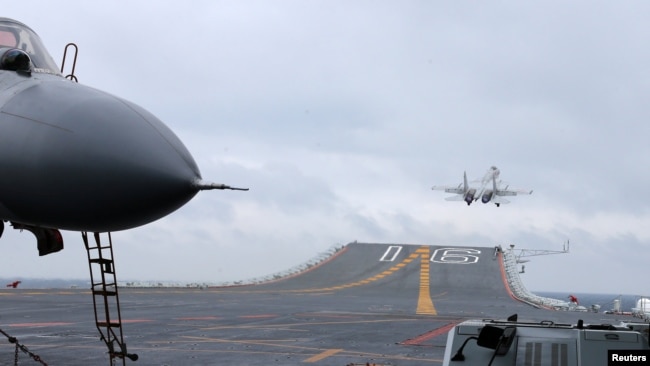
J-15 fighters from China's Liaoning aircraft carrier conduct a drill in an area of the South China Sea, on Jan. 2, 2017.
During his confirmation hearing, Rex Tillerson, the new U.S. Secretary of State, called China’s island building an “illegal” activity. He said, “We’re going to have to send China a clear signal that, first, the island-building stops; and, second, your access to those islands also is not going to be allowed.”
The comment drew sharp reaction from China. Lu Kang is a spokesman for China’s Foreign Ministry. In his daily briefing on Jan. 12, he said that China “has full right to conduct any kind of normal activities on its own territory within its sovereignty.”
The Global Times is a state-run news organization. It published a strongly worded editorial saying, “Unless Washington plans to wage a large-scale war in the South China Sea, any other approaches to prevent Chinese access to the islands will be foolish.”
China’s military capabilities
Military experts say China’s current military capabilities do not measure up to Beijing’s tough rhetoric on its continuing activities in the South China Sea.
Jeffrey Engstrom is a senior policy analyst at the RAND Corporation.
“Certainly things are more tense than they were just a few weeks ago. But I still don’t think we’re quite at the point of crisis, and certainly not at immediate confrontation.”
Engstrom said China’s navy is not nearly as well equipped as the United States.
The Liaoning is the only aircraft carrier in the Chinese naval fleet. It was first built for the Soviet navy and launched in Ukraine in 1988, but was never fully completed. It was upgraded and modernized for the People’s Liberation Army (PLA) Navy, which launched it in 2012.
The Liaoning is smaller than U.S. aircraft carriers and cannot support as many aircraft. It also has a “ski jump” type of system for launching aircraft instead of a catapult system. This limits the size of aircraft that can be launched, as well as how many weapons can be loaded onto the aircraft.
According to the U.S.-based research group the Center for Strategic and International Studies (CSIS), the Liaoning can carry up to 24 fighter jets and about 12 helicopters.
The U.S. Navy’s current Nimitz-class warships can handle more than 60 aircraft. One of these is the USS Ronald Reagan, stationed in Japan.

This image provided by the U.S. Navy shows the Nimitz-class aircraft carrier, USS Ronald Reagan underway in the Pacific Ocean Saturday March 12, 2011 enroute to Japan to render humanitarian assistance and disaster relief. (AP Photo/US Navy - Dylan McCord)
Since the Liaoning has only been fully operational for a few years, it also remains behind the U.S. Navy in experience and training.
Denny Roy is a senior fellow at the Hawaii-based East-West Center. He says China is getting a lot of experience using the Liaoning while building its own new carrier fleet.
“We understand that the Liaoning is primarily meant for training. Learning to operate an aircraft carrier takes many years, it’s extremely complicated. So it’s reasonable that the Chinese would start with a practice carrier, with the training wheels.”
Roy added that China is thought to be currently working on additional, more advanced aircraft carriers.
“We think there are more Chinese carriers under construction that will be larger, more capable - and these are intended to actually be prepared to fight.”
However, he added that even China’s carriers currently under construction will not have the same capacity as the new U.S. super carriers.
The United States is currently building a new class of aircraft carriers known as the Gerald R. Ford class. These $13 billion super carriers are even bigger than the Nimitz class. They can carry more than 4,500 people and at least 75 aircraft. The first of these, the USS Gerald Ford, is expected to be put into service in 2017.
Jeffrey Engstrom says despite the Liaoning’s limited capabilities, it serves as an important symbol of progress for China’s navy.
“The symbolism is that China is a great power. Great powers have aircraft carriers, and China too has an aircraft carrier.”
I’m Bryan Lynn.
________________________________________________________________

Words in This Story

navigation - n. process by which ships are successfully guided through water
drill – n. training activity conducted by soldiers​
approach – n. way of doing something
rhetoric - n. language intended to influence people that might not be honest or reasonable
fleet – n. a group of ships in a country’s navy
ski jump – n. a jump used by skiers to lift them into the air
catapult – n. device for launching a plane from the deck of an aircraft carrier
training wheels – n. small wheels attached to the back of a bicycle when someone is learning to ride it

English In The News: Giving Exiled Writers Security and Freedom


Ralph Henry Reese remembers clearly the day he and his wife decided to start City of Asylum Pittsburgh.
It was in 1997. He and his wife, Diane Samuels, were attending a talk by British Indian writer Salman Rushdie at the University of Pittsburgh. The famous author had just started making public appearances again after several years of hiding.
Rushdie’s 1989 novel ‘The Satanic Verses’ had offended many Muslims because of its portrayal of Islam. After its publication, the Supreme Leader of Iran issued a fatwa ordering Rushdie’s execution.
While in hiding, Rushdie and other writers in danger formed the International Parliament of Writers.The group urged cities in Europe to provide support and safety for writers in exile. These cities became known as “Cities of Asylum.” Writers who stayed in these cities could feel safe and secure again. More importantly, they could also enjoy freedom of expression again.
Rushdie spoke about the Cities of Asylum in that 1997 talk at the University of Pittsburgh. Almost immediately, Reese and Samuels started thinking about how they could make Pittsburgh a city of asylum, too.
Henry Reese, Co-founder of City of Asylum Pittsburgh
Reese grew up near Pittsburgh in a small town called Homestead, Pennsylvania. The area was home to one of the first big steel plants in the United States.
“A very famous small town because it was the site of the original labor riots back in the early steel industry. And it was sort of legendary and it was a much-studied community because of the turmoil and the immigrants in the community and the diversity of the people.”
For much of his adult life, Reese was an entrepreneur. He owned his own business. He describes himself as being able to create and develop ideas.
And in 1997, a new idea presented itself. Rushdie’s mention of European cities of asylum made Henry Reese and Diane Samuels think about how they – and the city of Pittsburgh – might be able to help writers in exile.
“He [Rushdie] talked briefly about the City of Asylum network in Europe. And Diane and I had a house at the time. We were renting out -- it had been at one time a crack house and we had acquired it to keep it from becoming a crack house again. And we thought, ‘what a perfect house for a writer.’”
Shortly after hearing Rushdie’s talk, Ralph Henry Reese wrote to the Cities of Asylum network in Europe. He expressed interest in giving a writer in danger to a safe place to live.
Several years went by before Reese and Samuels heard anything. Then, in 2003, they received an email. The Cities of Asylum program was looking to expand in the United States.
And one year later, the City of Asylum Pittsburgh opened its doors.
“City of Asylum Pittsburgh began to provide sanctuary to a writer exiled under threat of persecution. Persecution meaning the writer could be endangered with prison, violence or censored in a way that you can’t publish freely.”
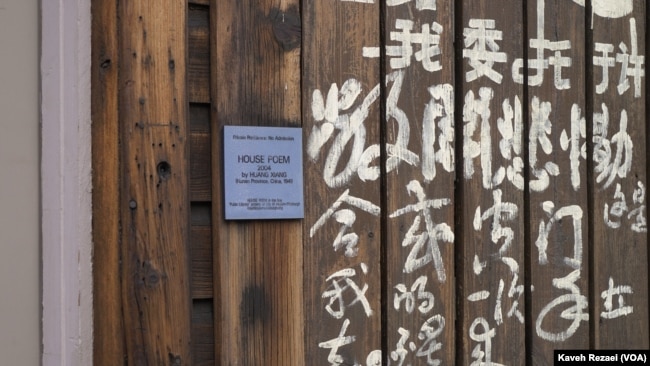
City of Asylum Pittsburgh’s first writer was Huang Xiang, a poet from China.
“When he came here he wanted to celebrate his freedom. He had never been allowed to express himself. [He had] never been published. He'd been tortured where his mouth had been beaten in so he couldn't even recite his poetry publicly, or they try to prevent it.”
When Huang arrived in Pittsburgh, Reese says, he wanted to “carve his poetry into the mountains outside the city.”
Huang spoke little English. He communicated through his wife, who translated for him. At first, Reese and Samuels thought they might have misunderstood Huang’s wishes.
"And we thought ‘Oh are we really hearing this?’”
Indeed, that was Huang’s wish. But, Samuels came up with an easier way for Huang to display his words.
“So Diane came up with the idea of putting his poetry on the outside of the house there. So he immediately came and did this beautiful calligraphy. It became a landmark instantly people came looking for it. He would come out and perform at his house.”
The row house was once a drug house. Now, it is decorated with Chinese poetry. Huang’s home is known as “House Poem.”
Today, City of Asylum Pittsburgh is made up of several row houses on the block of Samsponia Way. Its other houses have names. The names serve as reminders of the exiled writers who have lived there.
City of Asylum Pittsburgh has provided homes for exiled writers from six countries: China, El Salvador, Burma, Venezuela, Iran and Bangladesh. The program gives the writers a place to live, an income and medical benefits. It also provides support for them to continue being who they are: writers.
“We feel it’s extremely important that the writer maintain the identity of being a writer and the only way to do that, in exile, is to be published in the country you’re in.”
Reese says the City of Asylum Pittsburgh offers its writers a chance to express themselves freely, without threat. And for some, that feeling is entirely new.
“Freedom of expression can inspire many people in a deep way. This is a country -- the United States is a country -- where First Amendment rights and the idea to speak your mind is just so deeply ingrained that I think that is fundamental and everybody feels that is a sense of entitlement.
“But, I think everybody in this community understands the value of what we have here, and is more committed to understanding the meaning of creative expression, First Amendment rights in a different way, than maybe we did before. Because we have monuments in our midst, living monuments, who represent what it's like to lose that.”
I’m Marsha James.
________________________________________________________________

Words In This Story

appearance – n. the way that someone or something looks
portrayal – n. the act of showing or describing someone or something especially in a painting, book, etc.
fatwa – n. a ruling on a point of Islamic law given by a recognized authority.
turmoil – n. a state of confusion or disorder
crack house – n. a house or apartment where the illegal drug crack is made, used or sold
sanctuary – n. a place where someone or something is protected or given shelter
endangered – adj. seriously at risk or in danger
persecution - n. the unfair or cruel treatment treat of someone, especially because of race or religious or political beliefs
tortured – v. to cause someone to experience severe physical pain especially as a form of punishment to force that person to do something or say something
carve – v. to create something by cutting into a surface
calligraphy – n. the art of making beautiful handwriting
landmark – n. an object or structure on land that is easy to see and recognize
row house – n. a house in a row of houses that shares a wall with the houses next to it
entirely – adv. completely or fully: not lacking or leaving out any part
First Amendment – an amendment to the U.S. Constitution, ratified in 1791 as part of the Bill of Rights, prohibiting Congress from interfering with freedom of religion, speech, assembly, or petition.
ingrained – adj. existing for a long time and very difficult to change
fundamental – adj. forming or relating to the most important part of something
entitlement – n. the condition of having a right to have, do or get something
commitment – n. a promise to do or give something
midst – n. used to say that someone is among the people in a group

English In The News: Trump Fires Official Who Refused to Defend Travel Ban

U.S. President Donald Trump has removed Acting Attorney General Sally Yates for refusing to enforce or defend an executive order he signed last week limiting immigration.
The president appointed Dana Boente to replace Yates as the acting head of the Justice Department. Boente immediately cancelled Yates’ order and vowed to “defend the lawful orders of our president.”
The order stops all refugees from entering the United States for 120 days, and bans Syrian refugees indefinitely. It also blocks people from Iraq, Iran, Libya, Syria, Sudan, Yemen and Somalia.
The Associated Press noted that Yates’ removal was “a warning to other administration officials that Trump is prepared to terminate those who refuse to carry out his orders.” The news agency called the firing “an extraordinary public showdown.”
Yates was named to the second-highest position in the Justice Department by then-President Barack Obama. On Monday, she ordered the department’s lawyers not to defend the immigration order.
In a memo, she wrote, “At present, I am not convinced that the defense of the Executive Order is consistent with these responsibilities nor am I convinced that the Executive Order is lawful.”
The career prosecutor added: “For as long as I am the Acting Attorney General, the Department of Justice will not present arguments in defense of the Executive Order, unless and until I become convinced that it is appropriate to do so.”
A few hours later, Yates was fired. The White House press secretary released a statement saying Yates “betrayed the Department of Justice by refusing to enforce a legal order designed to protect the citizens of the United States.” It said the department’s Office of Legal Counsel approved the order.
Mixed reaction to the firing
Many Democrats criticized the decision to fire Yates. Steny Hoyer, a senior Democratic congressman, called the decision “alarming.” He said “the American people need to consider whether President Trump simply plans to dismiss anyone with whom he disagrees, and I hope my Republican colleagues stand up and express concern over this as well.”
Chuck Schumer is the Senate minority leader. He wrote on Twitter that the attorney general “should pledge fidelity to the law and the Constitution, not the White House. The fact that this [administration] doesn’t understand that is chilling.”
​But Republican Senator Ted Cruz strongly defended the decision to fire Yates. He said Yates’ refusal to support the executive order is a “fitting and sad” last act of Obama’s Department of Justice.
“President Trump was exactly right to fire an acting attorney general who refused to carry out her constitutional duty to enforce and defend the law,” Cruz said.
This week, the Senate Judiciary Committee is expected to approve the nomination of Senator Jeff Sessions for attorney general. He is expected to defend and enforce Trump’s immigration order.
Senator Sessions was a member of the Senate Judiciary Committee in 2015 when Yates was confirmed to be the deputy attorney general.
During a hearing on her confirmation, Sessions asked Yates: “If the views the president wants to execute are unlawful, should the attorney general or the deputy attorney general say no?”
Yates said she believed that “the attorney general or the deputy attorney general has an obligation to follow the law and the Constitution, and to give their independent legal advice to the president.”

I’m Anna Matteo.

Words in This Story

executive order – n. an order that comes from the U.S. President or a government agency and must be obeyed like a law
terminate – v. to take a job away from (someone)
betray – v. to do something that does not agree with (your beliefs, principles, etc.)
pledge – v. to formally promise to give or do (something)
fidelity – n. the quality of being faithful or loyal to a country, organization, etc. (usually + to)
chilling – adj. very disturbing or frightening
act – n. something that is done

English In The News: Trump Defends Travel Ban Despite Protests, Legal Action

President Donald Trump is defending his executive order that bans people from seven Muslim-majority countries from entering the United States.
The order was signed by Trump on Friday. It puts a 90-day entry ban on people from Iraq, Iran, Syria, Somalia, Sudan, Libya and Yemen. It also prevents refugees from entering the country for 120 days.
Trump has repeatedly called for more controls on U.S. immigration to improve national security and prevent terrorists from entering.
His administration has said U.S. policies used to investigate people coming into the United States from certain countries will be reviewed while the current ban is in place.
Travel ban led to protests
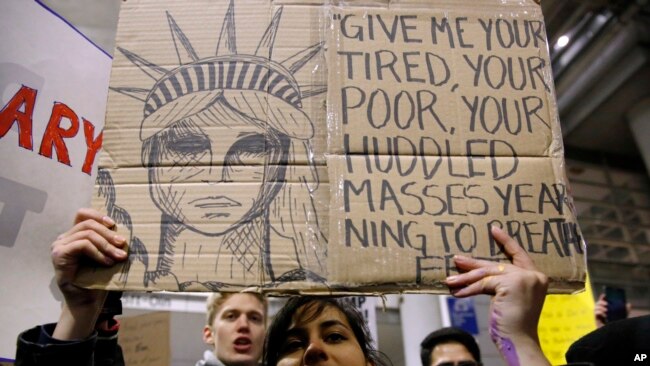
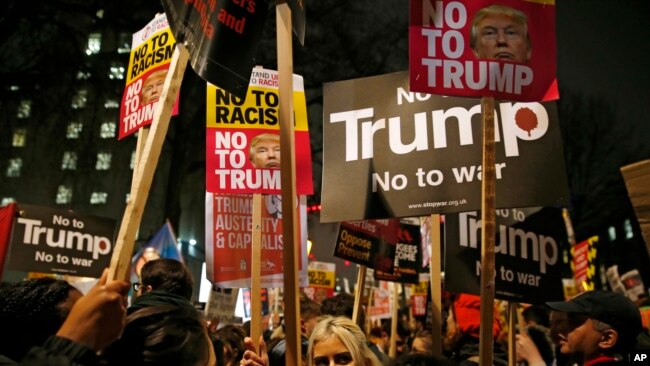
Thousands of people protested the order at U.S. airports and other locations, including the White House. Immigration groups, human rights activists and some foreign governments and organizations criticized the ban. Both Democratic and Republican lawmakers also spoke out against the order.
Demonstrators converge outside Terminal 5 of O'Hare International Airport, Jan. 29, 2017, in Chicago, as people protest President Donald Trump's executive order banning travel to the United States by citizens of several countries.
The order led to confusion at many American airports over the weekend. In some cases, people were detained at airports while holding legal documents allowing them to live and work in the United States.
A federal judge in New York took action Saturday to block the travel restrictions. Judge Ann Donnelly issued a temporary ban on deportations of people arriving at U.S. airports if they were carrying approved visas or refugee applications. Judges in several other states also issued rulings challenging Trump’s order.
The Department of Homeland Security said Sunday it planned to “comply with judicial orders.” It added that Trump’s order would continue to be enforced to make sure those entering “do not pose a threat to our country or the American people.”
Trump defended the travel ban
President Trump took to Twitter on Monday to defend the order. The tweet said, “There is nothing nice about searching for terrorists before they can enter the country. This was a big part of my campaign. Study the world!”

If the ban were announced with a one week notice, the "bad" would rush into our country during that week. A lot of bad "dudes" out there!
He defended the decision to launch the ban without notice. “If the ban were announced with a one week notice, the 'bad' would rush into our country during that week,” he tweeted.
Trump also took aim at Senate Minority Leader Chuck Schumer, who has criticized the travel restrictions. The Democratic senator appeared to hold back tears while speaking with reporters about the order.
At the White House Monday, Trump spoke about Schumer’s reaction. “I noticed Chuck Schumer yesterday with fake tears - I'm going to ask him who was his acting coach, because I know him very well. I don't see him as a crier.”
Other U.S. lawmakers were critical of the ban, including Republican Senators John McCain and Lindsey Graham.
The senators wrote in a joint statement, “We are particularly concerned by reports that this order went into effect with little to no consultation with the Departments of State, Defense, Justice and Homeland Security."
"Such a hasty process risks harmful results.”
Trump responded to the statement on Twitter, saying McCain and Graham were both "weak on immigration." He added that the two senators should be more focused on illegal immigration, border security and the Islamic State.

...Senators should focus their energies on ISIS, illegal immigration and border security instead of always looking to start World War III.
Senate Majority Leader Mitch McConnell expressed support for stronger immigrant screening, but said he opposes religious tests.
McConnell told ABC News, "I also think it's important to remember that some of our best sources in the war against radical Islamic terrorism are Muslims, both in this country and overseas."
Several Democrats in Congress said they planned to introduce legislation to stop Trump's travel ban.
Barack Obama: "American values are at stake"
Former President Barack Obama also responded to the travel ban and praised protesters for showing their opposition to it.
Obama's spokesman, Kevin Lewis, said, “The president fundamentally disagrees with the notion of discriminating against individuals because of their faith or religion."
It is the first time Obama has issued a statement about Trump since leaving office on January 20.
Some Trump administration officials have compared Trump’s order to a policy carried out under Obama. That policy, put in place in 2011, identified the same seven nations as places of concern for terrorism. But the Obama policy only related to individuals without a U.S. visa and was never considered a travel ban.
Obama spokesman Kevin Lewis added, “Citizens exercising their constitutional right to assemble, organize and have their voices heard by their elected officials is exactly what we expect to see when American values are at stake."
Reactions from overseas
Foreign leaders and organizations around the world were also critical of Trump’s order.
A spokesperson for the European Commission said the 28-nation group is currently studying the ban. In an interview, commission President Jean-Claude Juncker said choices had to be made “about the world we want to live in.” He said one choice is for, in his words, “isolationism and inequality,” while the other is to unite for social equality and strength.
Demonstrators hold banners as they take part in a protest against U.S President Donald Trump's controversial travel ban on refugees and people from seven mainly-Muslim countries, outside Downing Street in London, Monday, Jan. 30, 2017.
International aid group Doctors Without Borders accused Trump of keeping people "trapped in war zones, directly endangering their lives.” It called on the U.S. government to lift the ban and restart the resettlement of refugees.
In Germany, a foreign ministry spokesman said “tens of thousands” of people are likely to be affected by the travel ban. German Chancellor Angela Merkel expressed regret about order, but stopped short of condemning it.
The world's largest body of Islamic nations, the Organization of Islamic Cooperation, condemned the order in a statement. The 57-nation group called the policy “selective and discriminatory,” saying it will only fuel further extremist violence and terrorism.
Businesses criticized the travel ban
Google's chief executive Sundar Pichai said Trump’s travel ban could be “painful” for some of the 187 employees reportedly affected.
Facebook CEO Mark Zuckerberg added that the door should not be closed to refugees “and those who need help.”
In a statement to employees, Ford Motor Company said it opposed the travel restrictions. “We do not support this policy or any other that goes against our values as a company," it said.
Goldman Sachs Group Inc. Chief Executive Lloyd Blankfein also spoke out against the order. In a message to his employees, he said, “I would note that it has already been challenged in federal court, and some of the order has been enjoined at least temporarily."________________________________________________________________

Words in This Story

interpret – v. decide what something means
deportation– n. forced removal of someone from a country
fake– adj. false, not true
coach– n. someone who teaches people a skill or sport
hasty – adj. done or made very quickly
notion– n. idea or belief
assemble– v. gather together
enjoin– v. prevent from doing something